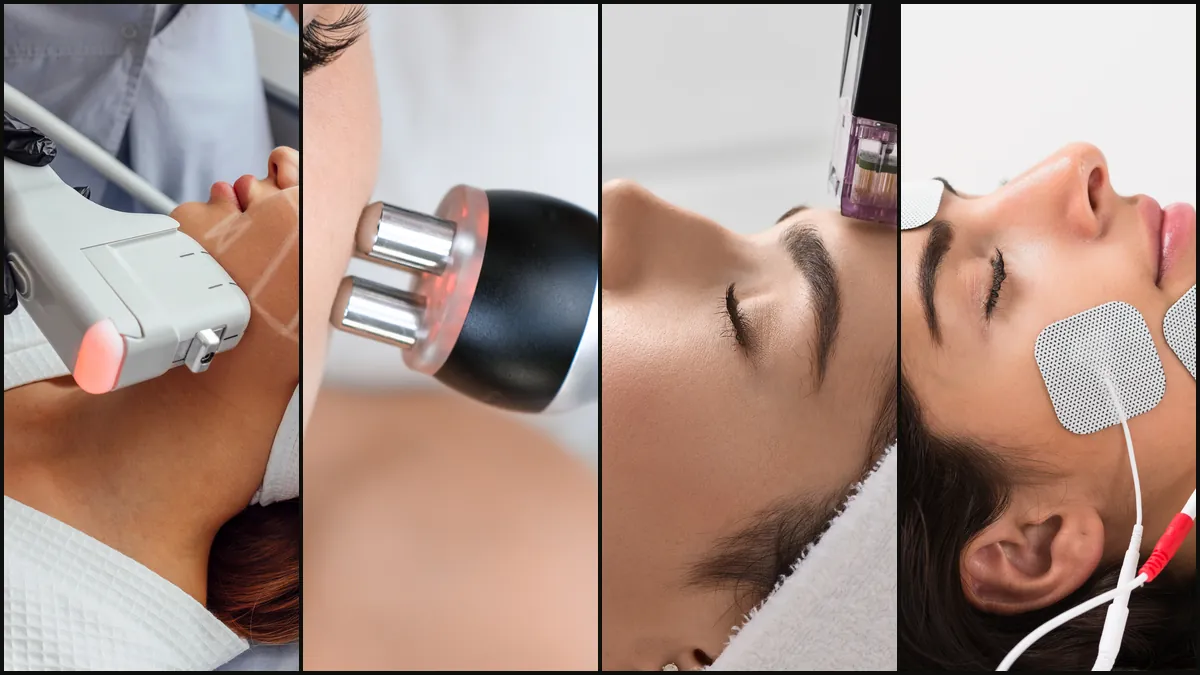
If you've Googled "HIFU vs RF Melbourne" and come away more confused than when you started, that's not your fault. Most of the marketing positions these technologies as direct competitors. They aren't. HIFU, RF, RF microneedling and EMS work on different layers of the face through different mechanisms, and the right choice depends on which layer is actually the problem.
This post breaks down what each technology does at a tissue level, what the published research supports (and doesn't), what each costs in Melbourne, and which situations each one suits. The goal is to leave you with enough information to walk into any Melbourne clinic and ask better questions. If it's your body rather than your face you're weighing up, see our companion comparison of EMS, fat freezing, HIFU and cavitation for body sculpting.
The short version: each technology works on a different layer of the face, so the right choice depends on what is actually sagging.
| Treatment | Targets | Best for |
|---|---|---|
| HIFU | SMAS (deep) | Skin laxity, jawline and neck lift |
| RF | Dermis | Early laxity, mild surface firming |
| RF microneedling | Dermis (deeper) | Fine lines, texture, acne scars |
| EMS | Muscle | Muscle tone and lift (the Kaizen Therapy approach) |
Why These Four Belong in the Same Conversation
The face is built in layers. From the surface down, you have skin (epidermis and dermis), then a fat layer, then a fibromuscular sheet called the SMAS (superficial musculoaponeurotic system), then the deeper facial muscles, and finally bone. When the face starts to look older, more than one layer is usually involved: the skin loses elasticity, the fat redistributes, the SMAS descends, and the muscles atrophy.
Each of the four technologies in this post hits a different layer. HIFU is the only one that reaches the SMAS non-invasively. Surface RF is mostly a dermal treatment. RF microneedling delivers RF deeper than the surface variant by physically bypassing the skin barrier. EMS works the muscles directly. Once you understand which layer each technology addresses, the choice becomes clearer than the marketing makes it look.
What the four have in common is that they are all energy-based, non-invasive, and don't involve injectables, threads or surgery. That's where the similarity ends.
The Four Technologies
HIFU (High-Intensity Focused Ultrasound)
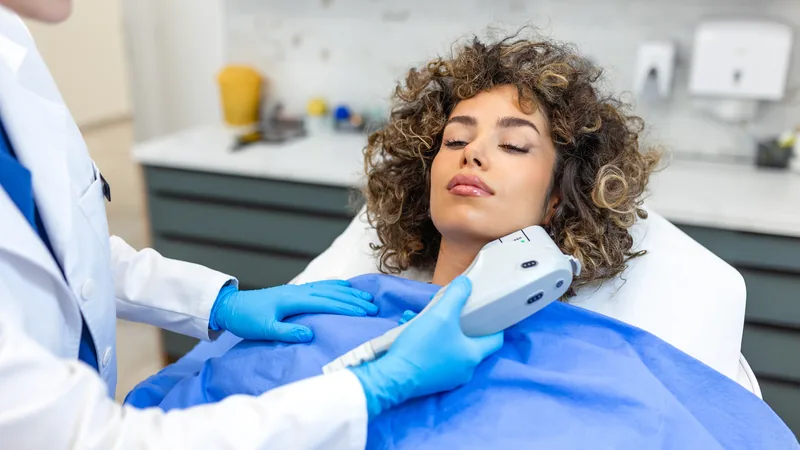
HIFU focuses ultrasound beams so they pass harmlessly through the upper layers of skin and converge at a defined depth, typically between 1.5 and 4.5 mm. At the focal point the tissue heats rapidly to around 60 to 70 degrees, which produces small zones of thermal coagulation. The body responds with immediate collagen contraction in those zones and a longer remodelling cascade over the following 8 to 12 weeks.
What makes HIFU different from the other three technologies in this post is depth. It is the only non-invasive option that consistently reaches the SMAS layer, which is the layer surgeons lift in a traditional facelift. The trade-off is that HIFU is a thermal-only treatment with no muscle component and limited effect on the very superficial dermis.
The 2025 systematic review by Wang et al. in Aesthetic Surgery Journal, pooling 45 studies published since 2010, reported skin tightness improvement in over 90% of treated patients, with measured laxity improvement ranging 18 to 30% on standardised rater scales. The strongest results clustered around the lower face, neck, and periorbital region. The original 2010 brow-lift study by Alam and White recorded a mean eyebrow elevation of 1.7 mm in 86% of subjects at 90 days post-treatment.
What it targets: SMAS-layer lifting, mid and lower face contouring, mild submental fat reduction.
Session time: 30 to 90 minutes per area.
Course: typically 1 session, repeated at 12 to 18 months.
Downtime: mild redness, transient tenderness. Bruising rare.
RF (Radiofrequency, surface-applied)
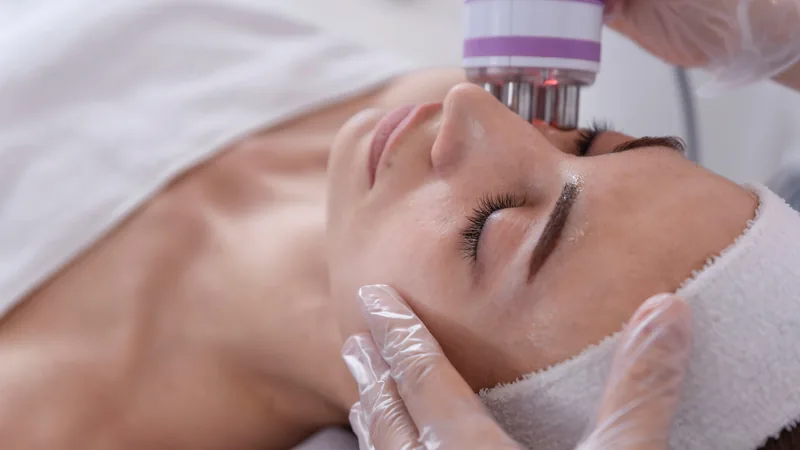
Radiofrequency in the surface form (think Pelleve, Thermage, Venus Viva, exilis Ultra) delivers electrical current between electrodes pressed against the skin. The tissue resists that current, which generates heat. The dermis warms to a controlled 42 to 44 degrees, which is hot enough to denature existing collagen fibres and trigger a remodelling response. New collagen synthesises over the following 8 to 12 weeks.
Surface RF is the most common interpretation of "RF skin tightening" in Melbourne. It's the option with the lowest barrier to entry, no downtime, and the most variable results. Outcomes depend heavily on device quality, operator technique, and the patient's starting laxity. Mild to moderate skin laxity responds reasonably well across a course of treatments. Severe laxity does not.
What it targets: dermal collagen remodelling, fine lines, mild laxity in the upper face.
Session time: 20 to 45 minutes.
Course: 4 to 8 sessions, 1 to 2 weeks apart, with maintenance.
Downtime: none to minimal redness.
RF Microneedling
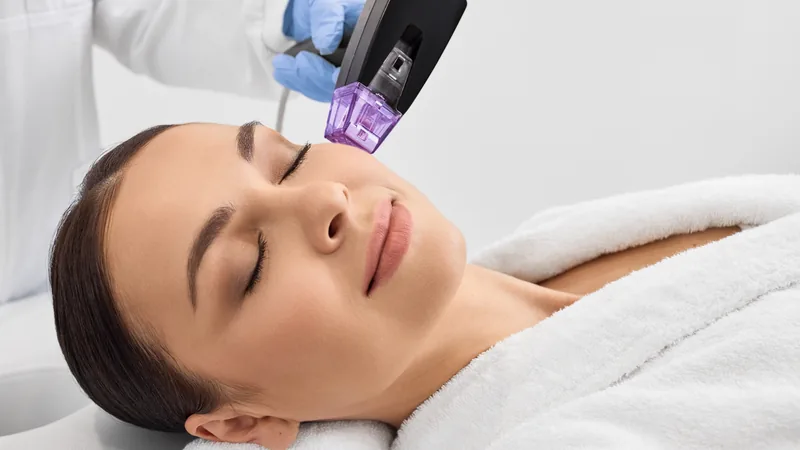
RF microneedling is a different category of treatment to surface RF, despite the shared name. A stamping handpiece drives an array of insulated microneedles (typically 24 to 49 needles per stamp) through the epidermis to a controlled depth between 0.5 and 4 mm. Once the needles are in position, RF energy is delivered from the needle tips directly into the dermis. The insulation prevents heating of the surface skin, so the thermal effect happens where it's needed without burning the epidermis on the way in.
This dual mechanism (mechanical injury from the needles, plus targeted thermal injury from the RF) drives a stronger collagen and elastin response than either microneedling or surface RF can produce alone. It's the most aggressive of the four technologies in this post and the only one with meaningful downtime: pinpoint bleeding, redness and swelling for 24 to 72 hours, with full social recovery typically at 5 to 7 days. Common Melbourne devices include Morpheus8, Genius RF, Vivace, Sylfirm X and Secret RF.
The strongest single number in the published literature comes from a 2025 comparative study in Aesthetic Surgery Journal: across 356 acne-scar patients, the 3-year relapse rate was 24% with fractional RF microneedling, compared with 67% for isotretinoin and 75% for ablative laser. For laxity specifically (rather than scarring), a retrospective series of 247 patients showed a 1.4-point improvement on the Baker Face/Neck Classification with 93% patient satisfaction. RF microneedling's evidence base is the most mature of the four technologies for textural and scarring outcomes.
What it targets: deeper rhytides, acne scarring, moderate skin laxity, stretch marks. Some submental fat reduction at deeper settings.
Session time: 45 to 75 minutes including topical numbing.
Course: 3 to 4 sessions, 4 to 6 weeks apart.
Downtime: 3 to 7 days of social recovery.
EMS for the Face (Neuromuscular Emission)
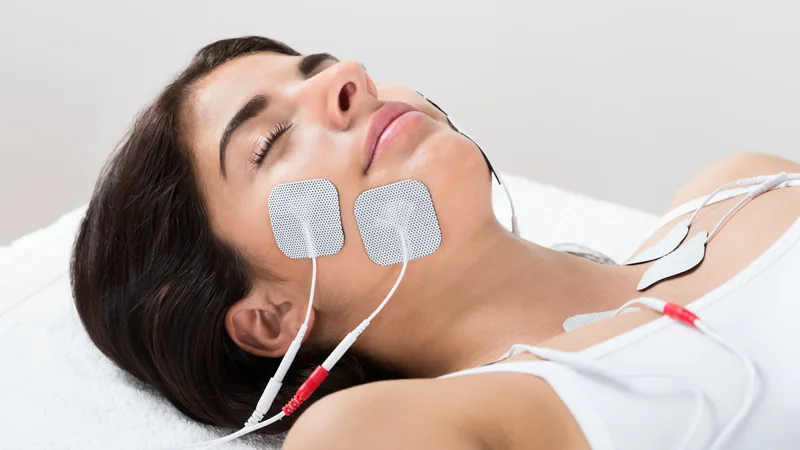
EMS for the face is the newest of the four categories. Devices use electromagnetic or electrical pulses to drive involuntary contractions in the SMAS-layer facial muscles: frontalis, zygomaticus major and minor, platysma, risorius, the submandibular group. The contractions are described as supra-maximal because the brain physically cannot recruit those motor units at that intensity through voluntary effort. The muscle work is, in effect, what a deep tissue workout would look like if you could isolate the small facial muscles the way an athlete trains a major muscle group.
Unlike the other three technologies, EMS for the face addresses the muscle layer rather than the skin or fat. That's a category difference, not a degree difference. If the face is descending because the underlying muscles have weakened (which happens with age regardless of skin condition), surface treatments will not fix it. Devices on the Australian market include WonderFace and EMFACE.
The mechanism evidence is still maturing. The 2023 Kinney porcine histology study in Aesthetic Surgery Journal showed a 21.2% increase in myonuclei count after 4 weekly treatments of synchronised RF and high-intensity facial muscle stimulation, alongside increased muscle-fibre diameter consistent with satellite-cell-mediated remodelling. The study used 6 sows, not human subjects, so we cite it as the mechanism reference rather than as efficacy evidence. The 2025 human study by Manuskiatti et al. in Lasers in Surgery and Medicine reported significant improvements in skin laxity, quality and patient-reported satisfaction across 15 subjects after 4 weekly EMFACE sessions.
What it targets: SMAS-layer muscle tone, midface lift, brow position, jawline definition.
Session time: 25 minutes.
Course: 12 sessions over 6 weeks at Kaizen Therapy (2 per week). Other Melbourne clinics offering EMFACE typically run shorter packs (4 sessions).
Downtime: none.
The Kaizen Therapy Approach: RF and EMS in One Session
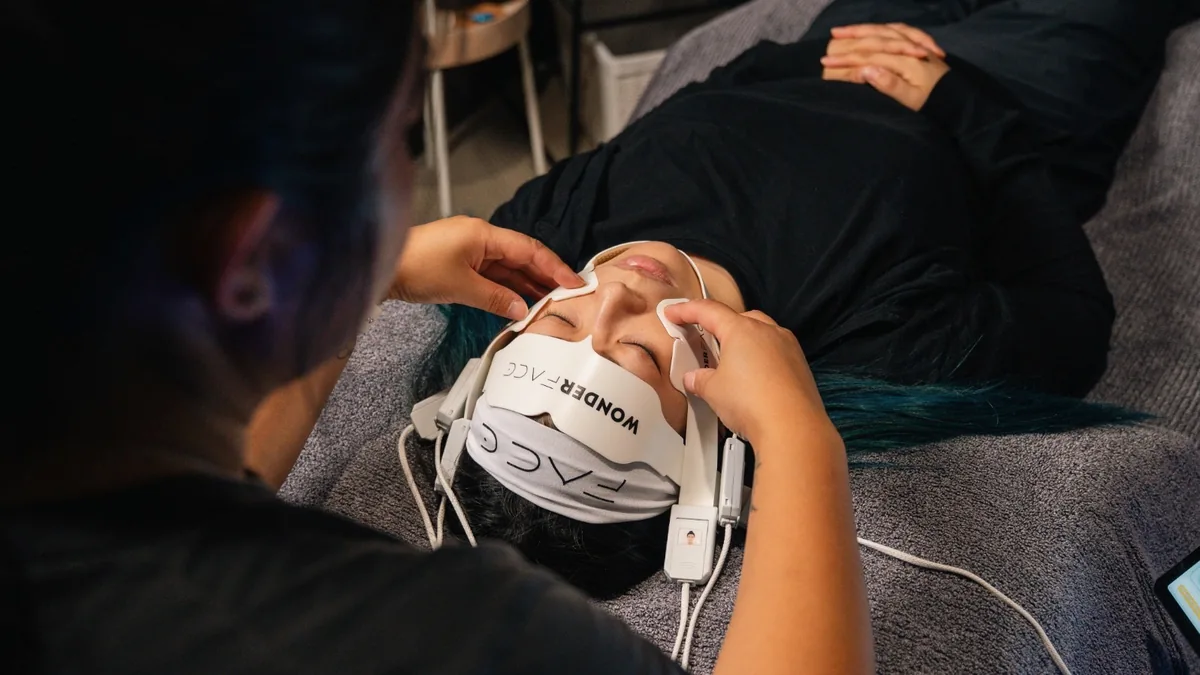
The four standalone technologies above each address a single layer well. WonderFace, the device we use at Kaizen Therapy, is the only TGA-listed system that runs bipolar radiofrequency and neuromuscular emission together in a single 25-minute session.
The RF component holds the dermis at 42 to 44 degrees to drive collagen and elastin remodelling. The neuromuscular emission delivers around 1,500 supra-maximal contractions per session to the SMAS-layer muscles. The dermal layer (skin) and the muscle layer get worked in parallel rather than as two separate appointments. We pulled the device specs and the protocol described here directly from the WonderFace operator guide and the eight peer-reviewed research papers behind it. The studies pooled over 200 subjects across Australia, Spain, Croatia, Poland, the United States, Belgium and Pakistan, with the largest single trial (85 subjects) run in Perth.
At Kaizen Therapy, the WonderFace program is structured as 12 sessions over 6 weeks (twice weekly) for $1,699 total, which works out at roughly $142 per session. Most clients see visible change by session 4 and full-program results 4 to 8 weeks after the final session. Monthly maintenance memberships start at $199/month if you want to extend results past the initial program.
See the full WonderFace program details →
Side-by-Side Comparison
| Factor | HIFU | RF | RF Micro | EMS |
|---|---|---|---|---|
| Layer | SMAS (deep) | Dermis | Dermis (deeper) | Muscle |
| Skin tightening | ✓ deep | Mild | ✓ | Indirect |
| Muscle lift | ✗ | ✗ | ✗ | ✓ |
| Fine lines | Mild | ✓ | ✓ best | Indirect |
| Per session | 30–90 min | 20–45 min | 45–75 min | 25 min |
| Sessions | 1 | 4–8 | 3–4 | 12 (Kaizen Therapy) |
| Downtime | Mild | None | 3–7 days | None |
| Visible at | 8–12 wk | 6–8 wk | 4–6 wk | 1–2 wk |
| Full course | $600–$1,800 | $1,200–$3,600 | $1,800–$6,000 | $1,699 (Kaizen Therapy) |
Notes: RF Microneedling is the only one of the four with strong evidence for acne-scar treatment. RF prices exclude Thermage, which is sold as a single $2,500–$4,000 treatment in Melbourne. The EMS column reflects Kaizen Therapy's WonderFace program (12 sessions over 6 weeks for $1,699, working out at roughly $142 per session). Other Melbourne clinics offering EMFACE typically charge $800–$995 per session across 4-session packs.
Which One Is Right for You?
The technology that suits you depends on which layer is the issue, how much downtime you can absorb, and what trade-offs make sense for your situation. Here's the honest breakdown.
Your skin is starting to sag and you want one big intervention
HIFU is the right tool. It's the only option in this list that reaches the SMAS layer in one go, and a single session can produce a meaningful lift. The result lasts roughly 12 to 18 months, after which you redo the treatment. If you don't want a series of appointments and you don't mind paying more upfront for a one-and-done outcome, this is the category.
You want skin tightening with zero downtime
Surface RF. The results are gradual and milder than the deeper technologies, but a course of sessions delivers cumulative dermal improvement without taking you out of your social calendar. It's also the most forgiving entry point if you've never had energy-based facial work and want to see how your skin responds.
You have acne scarring or deeper textural issues
RF microneedling. It's the only one of the four with strong evidence for acne scar remodelling, because the needle channels physically reach the depth where the scar tissue sits. Surface RF and HIFU don't address texture at that level. EMS doesn't touch skin at all. The trade-off is the downtime: budget a long weekend.
Your face has lost lift, not just tone
EMS for the face. Loss of muscle tone is a structural issue that creams, lasers, ultrasound and surface RF cannot fix, because none of them work the muscle layer. If your face looks "tired" rather than "lined", and especially if you've noticed your cheeks descending or your jawline softening, the muscles are usually the problem before the skin is.
You want to address skin and muscle at the same time
This is the case WonderFace was designed for. Bipolar RF works the dermis while neuromuscular emission works the SMAS muscles, in the same 25-minute session. It's the only TGA-listed device that combines both in one appointment, which is why we use it. See the WonderFace protocol →
Not sure which layer is your issue?
Book a free WonderFace consult. We'll do a no-pressure facial assessment and tell you honestly which technology category suits you. If WonderFace isn't the right fit, we'll say so.
BOOK FREE FACIAL ASSESSMENT →What the Research Actually Shows on EMS for the Face
The four-technology comparison is fair until you get to evidence. The clinical literature behind each category sits at different levels of maturity. HIFU and surface RF have decades of trial data, RF microneedling has a strong body of work since around 2013, and EMS for the face is the newest entrant. Because EMS is the technology that stands up to the most reader scepticism, it's worth examining the evidence directly.
The data we hold for WonderFace pools roughly 200 subjects across eight published case series, run in Croatia, Australia, Spain, Poland, the United States, Belgium and Pakistan. The single largest study (Marshal, 85 subjects) was conducted at Derma Beauty Clinic in Perth, using a 250 Hz lifting programme over 4 weekly sessions. Skin types tested cover Fitzpatrick I through V. The age range studied is 25 to 70. All eight are open-label observational designs, not sham-controlled randomised trials. We frame the numbers below as "early clinical evidence" rather than as Level 1 evidence.
- Wrinkle reduction: up to 50% improvement in patients aged 35 to 50; 20% average across studies
- Muscle tone increase: up to 25% after 8 to 12 sessions
- Lifting effect reported: 100% of subjects (Paper 1)
- Skin texture, tone and fine lines: 100% report improvement (Paper 8)
- Midface and cheek lifting: 75% (Paper 8)
- Jawline improvement: 70% (Paper 8)
- Patient satisfaction: 100% across all studies
One finding worth noting: the strongest individual response in the dataset comes from male patients, who are typically resistant to injectable approaches. The mechanism is not about gender per se. It's about facial muscle mass: patients who start with more muscle to work tend to show larger objective improvements after a course. That pattern is the opposite of the thermal technologies, where outcomes are usually stronger on patients with thinner, more accessible tissue.
Importantly, the published data also lists what EMS for the face does not do well. It does not treat acne scarring (no needle delivery), it does not address pigmentation, and it does not provide the deep one-time lift HIFU does. It is a muscle-tone treatment with collateral skin benefits, not a skin-resurfacing or deep-lifting treatment. The honest read is that it's a powerful tool for the right indication, not a universal replacement for the other three categories.
Common Myths
"HIFU is the strongest, so it's always the best"
Strongest does not mean broadest. HIFU reaches deep, but it doesn't address muscle tone, fine surface lines, or skin texture. If your issue is dermal (lines, texture, mild laxity), HIFU is overkill and won't outperform surface RF or RF microneedling for those specific outcomes. If your issue is muscle descent, HIFU does nothing useful. The right tool depends on the layer that needs work.
"RF microneedling is just RF with extra steps"
Different mechanism, different category. The needle channels deliver RF directly into the dermis, bypassing the resistive losses that limit how deep surface RF can effectively reach. That's why a 3 to 4 session RF microneedling course can outperform a 6 to 8 session surface RF course on similar laxity. The downtime is the price you pay for the depth.
"EMS for the face is just a fancy face workout"
It isn't. Voluntary facial exercise can recruit the larger expression muscles a bit, but it cannot drive supra-maximal contractions in the SMAS-layer muscles, because the central nervous system caps voluntary recruitment well below the muscle's mechanical capacity. WonderFace produces around 1,500 contractions per 25-minute session at an intensity the brain physically cannot generate. The 2023 Kinney porcine study showed that this kind of stimulation produces measurable structural change in muscle tissue (a 21.2% increase in myonuclei after 4 weekly sessions) which voluntary effort has never been documented to do. Facial yoga is a different intervention.
"You have to pick one technology and stick with it"
You don't. Combinations are routine in cosmetic dermatology, and some pairings make particular sense. HIFU plus EMS is a strong stack: HIFU gives the deep one-time lift, EMS maintains the muscle tone underneath it. RF plus EMS in one session is what WonderFace is built around. The pairing to avoid is HIFU and RF microneedling within six weeks of each other, because the cumulative thermal injury raises the risk of pigment changes.
Facial Contouring in Melbourne: Where the Four Technologies Fit
"Facial contouring" is the umbrella term Melbourne clinics use for reshaping how structure and light sit on the face: a more defined jawline, a cleaner under-chin angle, lifted cheeks, a slimmer overall look. Searches for face sculpting and face slimming land in the same category. The term confuses people because it spans two completely different toolsets. One is surgical and injectable: buccal fat removal, chin implants, jaw-slimming injections, dermal filler. The other is the energy-based set this article compares.
On the energy-based side, the mapping follows the layers. Jawline definition and jowls are driven substantially by the muscle layer, which makes EMS the anchor technology there; our guide to sagging jowls without surgery walks through that decision in depth. The under-chin profile is a skin-plus-muscle problem, covered fully in our double chin cost guide. Cheek lift is mostly skin and connective tissue, which is where HIFU and RF microneedling earn their place. Face slimming through fat reduction is the one contouring job none of these four technologies does well; small facial fat pads are injector or surgeon territory, and a clinic that says otherwise is stretching.
At Kaizen Therapy, facial contouring runs through the WonderFace program: bipolar RF and neuromuscular emissions across the frontal, zygomatic and submaxillary zones, twelve sessions over six weeks. Your free assessment is where we map which of your contouring goals sit in the energy-based column and which would honestly be better served elsewhere.
Frequently Asked Questions
HIFU is safe when delivered on a TGA-listed device by a properly trained operator. The risks tend to be operator-dependent rather than technology-dependent. The two most-cited adverse outcomes in the published literature are temporary nerve numbness (usually around the marginal mandibular nerve) and fat atrophy in patients with thin subcutaneous tissue. Both are minimised by accurate depth selection and correct mapping of the treatment grid. Before booking, ask which specific device the clinic uses, how many sessions the operator has performed, and whether they map the facial nerve before treatment.
HIFU results typically last 12 to 18 months, after which the laxity returns gradually as collagen turnover catches up with age-related loss. Surface RF results last 6 to 12 months and almost always require maintenance every few months to sustain the result. RF microneedling sits in between, with most patients reporting noticeable benefit at 12 to 24 months post-course. EMS for the face requires the most ongoing maintenance: at Kaizen Therapy the WonderFace program is 12 sessions over 6 weeks, with results lasting 6+ months and monthly maintenance memberships available afterwards (from $199/month). The differences in longevity reflect the depth of the treatment effect, not the quality of any individual technology.
For mild to moderate skin laxity, the published evidence is reasonable. Combining needle channels with thermal RF energy bypasses the resistive losses that limit how deep surface RF can reach, which is why RF microneedling tends to outperform surface RF for the same number of sessions. For severe laxity, including significant jowl descent or platysmal banding, the answer changes. At that point the clinical conversation is between deeper energy devices like HIFU or surgical options. RF microneedling will not lift severely sagging tissue, despite what some marketing suggests.
It depends on what is causing the jowl. If the descent is driven by weakening of the cheek and jaw musculature, the right tool is EMS for the face, because it directly retrains the SMAS-layer muscles that hold the lower face up. If the descent is mostly skin laxity over preserved bone and muscle structure, HIFU or RF microneedling is more appropriate. WonderFace is the only device on the Australian market that combines bipolar RF and neuromuscular emission in one 25-minute session, addressing both layers at once. A proper assessment looks at which layer is the main contributor before recommending a technology.
Yes, and the combinations make sense for different reasons. HIFU plus EMS is a coherent stack: HIFU provides the one-time deep tissue lift, and EMS maintains the muscle tone that supports the result. Surface RF can be run in series with EMS without conflict, which is essentially what WonderFace does in a single session by integrating the two modalities. The combination to avoid is HIFU plus RF microneedling within the same six-week window, because the cumulative thermal injury has been associated with slower healing and an increased risk of post-inflammatory pigment changes. Spacing them out by at least six weeks is the conservative approach.
No. A facelift is one specific surgical procedure that repositions the SMAS layer and removes excess skin, sitting at the far end of the contouring spectrum. Facial contouring is the umbrella term for everything that reshapes the face, and most of what Melbourne clinics sell under it is non-surgical: HIFU, RF and RF microneedling for skin tightening, EMS for muscle-layer lift and jawline definition, and injectables for volume. The four technologies compared in this article cover the energy-based portion of that spectrum. Which contouring tool is right depends on whether the change you want lives in the skin, the muscle, the fat or the bone, and an honest assessment names the layer before it names a machine.
Studies cited
- Wang J, Lee Y, Coleman WP III, et al. A Systematic Review of High-Intensity Focused Ultrasound in Skin Tightening and Body Contouring. Aesthetic Surgery Journal. 2025;45(7):690–702. PMID 40184185.
- Alam M, White LE, Martin N, Witherspoon J, Yoo S, West DP. Ultrasound tightening of facial and neck skin: a rater-blinded prospective cohort study. Journal of the American Academy of Dermatology. 2010;62(2):262–269.
- The Role of Fractional Radiofrequency in Long-term Acne Remission and Reduction of Acne Scar Load. Aesthetic Surgery Journal. 2025;45(Suppl 1):S23. PMC 11736774.
- Multimodal Radiofrequency Application for Lower Face and Neck Laxity. PMC 7489644.
- Long-Term Efficacy and Safety of a Novel Monopolar Radiofrequency Device for Skin Tightening: A Prospective Randomized Controlled Study. PubMed 39957006 (2025).
- Kinney BM, Bernardy J, Jarošová R. Novel Technology for Facial Muscle Stimulation Combined With Synchronized Radiofrequency Induces Structural Changes in Muscle Tissue: Porcine Histology Study. Aesthetic Surgery Journal. 2023;43(8):920–928. PMID 36883601.
- Manuskiatti W, et al. The Efficacy and Safety of Synchronized Radiofrequency and High-Intensity Facial Electrical Stimulation in Improving Facial Skin Laxity and Quality in Asians. Lasers in Surgery and Medicine. 2025. DOI 10.1002/lsm.23878.
- Marshal T. Facial Rejuvenation Treatment with Independent Application of Radiofrequency and Neuromuscular Emissions Using the WonderFace Device. Derma Beauty Clinic, Perth, Australia. 85 subjects, 4 weekly sessions, 250 Hz lifting programme.
- Švaganović S. Approach for Facial Rejuvenation and Wrinkle Reduction Using Combined Bipolar Radiofrequency and Neuromuscular Emission with WonderFace. Zagreb, Croatia. 16 subjects, two age cohorts.
- Compere A. WonderFace: Mechanism, Protocol and Clinical Observations. Allesthetic Clinic, Namur, Belgium.