If you've searched "pelvic floor physio Melbourne" and ended up on a page selling a chair, you've probably wondered how the two even relate. Are they the same thing? Is one better? Is the chair just a shortcut for people who can't be bothered doing their exercises?
None of those framings are quite right. Pelvic floor physiotherapy does a genuinely different job from the electromagnetic devices that build the muscle for you, and there are two of those worth knowing about: the seated EMS chair you'll see marketed everywhere, and WonderAxon, the worn system we use at Kaizen Therapy. The most useful way to think about all three is as a sequence rather than a contest. This guide walks through what each one actually does, what the research supports and what it doesn't, and how a new mum in Melbourne can decide where to start. The short version up front: see a physio first, then decide whether a machine adds anything for you.
What Pelvic Floor Physio Actually Does
A pelvic health physiotherapist assesses and retrains the muscles of the pelvic floor. The first appointment usually includes an internal examination. It sounds confronting, but it's the only way to measure what your pelvic floor is actually doing: whether it contracts, whether it relaxes, whether the left and right sides fire evenly, and whether there's a diastasis recti (a separation in the abdominal wall) sitting above it.
From there, the physio builds a program for you specifically. No machine replicates that part. They watch you contract, correct what you're doing, and progress the load as you improve. Supervised pelvic floor muscle training has a strong evidence base. A 2018 Cochrane review pooling 31 trials and 1,817 women found that women doing supervised training were far more likely to report resolution of stress urinary incontinence than those doing nothing (around 56% versus 6%). For prevention, a larger Cochrane review of nearly 9,900 women found that training during and after pregnancy lowered the risk of urinary leaking in the months after birth.
This is why physio is the right first step, and why we say so even though we offer a machine of our own. If you've never had your pelvic floor assessed, you're guessing. A physio replaces the guessing with a measurement and a plan.
Why Progress Can Stall After Physio
Here's the honest part most clinics skip. Pelvic floor exercises work, but only if two things happen: you do them correctly, and you do enough of them, consistently, for long enough. Both are harder than they sound.
On technique, the numbers are sobering. In a frequently cited 1991 study, researchers checked how well 47 women performed a pelvic floor contraction after brief verbal instruction. Only 49% managed an ideal contraction. A quarter were using a technique that could actually push down rather than lift, the opposite of what's intended. A larger 2013 study of 779 women found that about 15% couldn't initially contract correctly, though most learned quickly once someone showed them. The takeaway isn't that Kegels don't work. It's that a written instruction sheet is not the same as being taught, which is exactly the gap a physio closes.
Then there's volume. Even with perfect technique, a home program asks you to remember sets of contractions every day, between feeds, broken sleep, and a body that's still recovering. Recovery itself is slower than the calendar suggests. A 2022 study tracking 235 first-time mothers found pelvic floor muscle strength sat around 54% below its mid-pregnancy level early after a vaginal birth, and was still measurably below baseline a full year later. The six-week check is an administrative milestone, not a finish line.
So plenty of women do everything right and still feel stuck a year on. Not because they failed. Because consistent high-volume muscle work is hard to sustain on your own. That's when a different tool is worth looking at.
Not sure where you're up to?
Book a free pelvic floor assessment at our Bentleigh studio. We'll do a body scan, talk through what you've already tried, and give you a straight answer on what your next step should be.
BOOK A FREE PELVIC FLOOR ASSESSMENT →What the EMS Chair Adds
The EMS chair (you'll also see it called a HIFEM chair or electromagnetic chair) takes a different approach to the same muscles. You sit on it fully clothed, and the device uses focused electromagnetic energy to drive involuntary contractions in the pelvic floor and deep core. The contractions are stronger and far more frequent than you can produce voluntarily, because your nervous system caps how hard you can fire those muscles on purpose. The chair bypasses that cap.
The headline number you'll see quoted is tens of thousands of contractions in a single 25-minute session. It's worth being precise about what that figure is: it's the manufacturer's specification for the device, not a clinical outcome. It describes how the machine works, not a result it guarantees. We think that distinction matters, because a lot of marketing blurs the two.
On outcomes, the clinical picture is encouraging but narrower than the ads suggest. The most-cited study, published in 2019, treated 75 women and reported a 64% improvement in incontinence symptom scores and roughly halved pad use at three months. A 2021 comparative study found the electromagnetic approach outperformed conventional electrostimulation on pelvic floor symptom scores. Both are genuinely positive, with one important caveat for the readers of this article: those study groups were older women, average age in the mid-fifties, not postpartum mums. There is, as yet, no large published trial of the chair specifically in the months after birth. We'd rather tell you that than imply a certainty the research doesn't support.
What the chair clearly offers is volume and convenience: a high dose of muscle work, supervised, with nothing to remember and nothing to undress for. What it doesn't offer is assessment or technique correction. It contracts the muscles for you, which is the strength and the limitation in one sentence.
Where WonderAxon Fits, and Why It Isn't a Chair
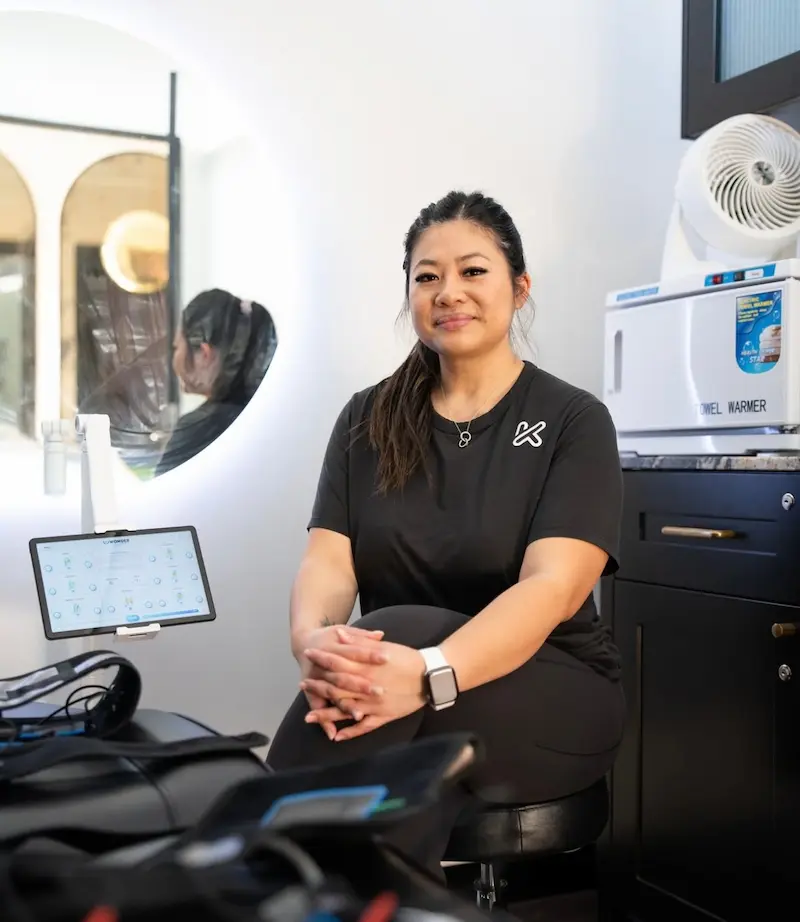
WonderAxon is the tool we use at Kaizen Therapy, and it belongs to the same technology family as the chair: high-intensity focused electromagnetic muscle stimulation. The difference is delivery. Instead of a seat, WonderAxon is a worn system. You change into a fitted treatment garment, we mist the working areas with warm water so the current conducts cleanly to the muscle, and the applicators sit against your deep core and pelvic floor for a 25-minute session. A radiofrequency component heats the tissue while the muscle work is happening.
Two things follow from that design. Because the applicators are placed rather than built into a seat, the same device works the deep abdominal wall and the pelvic floor together, and those two recover as a pair after birth. And because the postpartum body-restoration work and the pelvic floor work are just different programs on the same device, one session can cover both rather than splitting them across separate appointments.
The honesty caveats are the same as for the chair. The contraction counts you'll see quoted, 36,000 or more in a session, are the device's operating specification, not a promised result. And on the one axis that matters most here, WonderAxon does exactly what the chair does: it contracts the muscle for you. It does not assess you, and it does not correct your technique. That is why the order still starts with a physio.
Side-by-Side: Physio vs EMS Chair vs WonderAxon
Read this as different roles, not a winner and a loser. The columns describe what each option is good at, so you can see why the order matters more than the pick.
| Factor | Pelvic Floor Physio | EMS Chair | WonderAxon |
|---|---|---|---|
| Main job | Assess, teach correct technique, build a tailored program | Add high-volume contraction from a seat | Add high-volume deep-core and pelvic floor contraction from a worn system |
| Individual assessment | Yes — internal exam, diastasis check | Screening only | Screening plus a Styku 3D body scan; physio first if you need it |
| Technique correction | Yes — the core strength of physio | No — it contracts the muscles for you | No — it contracts the muscles for you |
| Contraction volume | Limited by voluntary effort and fatigue | Tens of thousands per session (device spec) | 36,000+ per session (device spec) |
| Setup | Clothed, hands-on | Sit fully clothed | Change into a treatment garment; areas misted with warm water |
| Tissue technology | None — muscle training | Electromagnetic muscle stimulation | Electromagnetic stimulation plus radiofrequency |
| Evidence base | Strong, including Cochrane reviews | Emerging; strongest data is in older women | Same HIFEM technology class; postpartum data still emerging |
| Best for | First step; learning correct activation; diastasis | Adding volume once you've been assessed | Adding volume plus core and body restoration, once assessed |
| Downtime | None | None | None |
The honest summary: physio is the evidence-based starting point and the only option that can assess you and fix your technique. The EMS chair and WonderAxon are both ways to add muscle volume once you know what you're working with. Neither is a substitute for the assessment.
How They Work Together
The sequence is straightforward. Start with a pelvic health physio. Get assessed, learn to activate the right muscles correctly, and find out whether you have a diastasis or any issue that needs hands-on attention first. Give a focused home program a fair run.
If you reach a plateau, or you're doing everything right and want to build on it, that's when WonderAxon earns its place. By then you understand your own body, you know you're contracting correctly, and WonderAxon becomes a way to layer on the kind of contraction volume that's genuinely hard to hit at home. The deep core and the pelvic floor recover together, too, which is why we work them in the same session. A 2016 study following 300 women found around 60% had a diastasis at six weeks postpartum, falling to about a third by twelve months, so the abdominal wall is often still a work in progress when women come to us.
That's how our postnatal program is built. We screen every client at a free assessment, and if you haven't seen a physio yet, we'll send you there first. We'd rather lose the booking than put someone on a machine who'd get more from a physio. WonderAxon is the next step, not the only step.
The next step, not the only step
Our postnatal recovery program uses WonderAxon, a worn EMS system rather than a chair: 25-minute sessions, twice a week, for 12 weeks. Every client starts with a free pelvic floor assessment and a Styku 3D body scan, so we can track real change rather than guess at it.
SEE THE POSTNATAL PROGRAM →When to Start, and What to Ask
Timing matters more after birth than the marketing usually admits. A few things worth knowing before you book anything:
- Give it time. We start clients from six months postpartum. The pelvic floor is frequently still recovering well past that point, and there's no prize for rushing.
- Breastfeeding is a wait, not a no. Active breastfeeding and pregnancy are both contraindications for the WonderAxon device, so we wait until breastfeeding is complete. You can still come in for your assessment and scan beforehand.
- C-section needs clearance. If you had a caesarean, we ask for GP clearance and at least six months of healing, and we tailor the early sessions around your scar.
- Implants and a few medical conditions rule it out. Electronic or metallic implants and certain health conditions are contraindications. We screen for all of this at the free assessment, which is the whole point of doing one.
When you call any clinic, pelvic floor physio or a muscle-stimulation device, ask the same blunt questions: who assesses me, what are they measuring, and how will we know if it's working? A good provider will have a clear answer. If the answer is "just trust the machine," keep looking.
Cost and Program at Kaizen Therapy
Vague pricing is one of the most common complaints about this industry, so here's exactly what the program costs and what's in it.
The 12-week program is $2,399. That covers 24 sessions (two per week across 12 weeks), three Styku 3D body scans to track change objectively, your postnatal recovery plan, access to the client portal, two bonus maintenance sessions, and direct support from the studio. There's a payment plan of $200 per week for 12 weeks, with no interest and no credit checks.
Your first step is free: a 15-minute pelvic floor assessment and body scan, no obligation. If we don't think you're a fit, whether you're still breastfeeding, would benefit from physio first, or aren't ready yet, we'll tell you. You can book that free assessment here.
Frequently Asked Questions
See a pelvic health physiotherapist first. They are the only option here that can assess your pelvic floor directly, check for a diastasis, and tell you whether you are even contracting the right muscles. The published evidence for supervised pelvic floor muscle training is strong, and it is the recommended starting point. WonderAxon makes sense as a next step once you have had that assessment and want to build on it, especially if progress has stalled. At your free assessment we will tell you honestly if you would be better served seeing a physio first.
No. They do different jobs. Physio teaches your body how to recruit and coordinate the pelvic floor and deep core, and it corrects technique that no machine can correct for you. WonderAxon adds contraction volume and load that is hard to reach through voluntary effort alone. We treat them as complementary, not competing. Most of our clients have already done the Kegels and seen a physio and are looking for the next step rather than a substitute.
We start clients from 6 months postpartum, and not while breastfeeding. Pregnancy and active breastfeeding are both contraindications for the WonderAxon device, so we wait until breastfeeding is complete before any sessions. You are welcome to come in earlier for your free assessment and body scan so you are ready to begin the moment you are eligible. The pelvic floor is often still recovering well past the standard 6-week check, so there is no rush to start before your body is ready.
Yes, with GP clearance and at least 6 months of healing. The deep core and pelvic floor work is just as relevant after a caesarean. Some research suggests the pelvic floor may be less affected by a C-section than a vaginal birth, though both benefit from recovery work. Mention your C-section at your free assessment so we can tailor the first few sessions around your recovery and your scar.
You change into a fitted treatment garment we provide. It's a quick, private change. Then we mist the working areas with warm water so the current conducts cleanly to the muscle. From there it is a 25-minute session with no internal device. Most people describe the sensation as a deep, rhythmic muscle contraction rather than pain, and many scroll their phone or chat through it. The intensity starts low and builds as you get used to it.
The 12-week program is $2,399. That covers 24 sessions (two per week for 12 weeks), three Styku 3D body scans, your postnatal recovery plan, the client portal, two bonus maintenance sessions and direct studio support. There is a payment plan of $200 per week for 12 weeks, with no interest and no credit checks. Your initial pelvic floor assessment and body scan are free and carry no obligation.
Studies referenced
- Dumoulin C, Cacciari LP, Hay-Smith EJC. Pelvic floor muscle training versus no treatment, or inactive control treatments, for urinary incontinence in women. Cochrane Database of Systematic Reviews. 2018;(10):CD005654. PMID 30288727.
- Woodley SJ, Boyle R, Cody JD, Mørkved S, Hay-Smith EJC. Pelvic floor muscle training for preventing and treating urinary and faecal incontinence in antenatal and postnatal women. Cochrane Database of Systematic Reviews. 2017;(12):CD007471. PMID 29271473.
- Bump RC, Hurt WG, Fantl JA, Wyman JF. Assessment of Kegel pelvic muscle exercise performance after brief verbal instruction. American Journal of Obstetrics and Gynecology. 1991;165(2):322–327. PMID 1872333.
- Henderson JW, Wang S, Egger MJ, Masters M, Nygaard I. Can women correctly contract their pelvic floor muscles without formal instruction? Female Pelvic Medicine & Reconstructive Surgery. 2013;19(1):8–12. PMID 23321652.
- Bø K, Næss K, Stær-Jensen J, Siafarikas F, Engh ME, Hilde G. Recovery of pelvic floor muscle strength and endurance 6 and 12 months postpartum in primiparous women. International Urogynecology Journal. 2022. PMID 36048249.
- Samuels JB, Pezzella A, Berenholz J, Alinsod R. Safety and Efficacy of a Non-Invasive HIFEM Device for the Treatment of Urinary Incontinence and Enhancement of Quality of Life. Lasers in Surgery and Medicine. 2019;51(9):760–766. PMID 31172580.
- Silantyeva E, Zarkovic D, Astafeva E, et al. A Comparative Study on the Effects of HIFEM Technology and Electrostimulation for the Treatment of Pelvic Floor Muscles and Urinary Incontinence in Parous Women. Female Pelvic Medicine & Reconstructive Surgery. 2021;27(4):269–273. PMID 31860567.
- Sperstad JB, Tennfjord MK, Hilde G, Ellström-Engh M, Bø K. Diastasis recti abdominis during pregnancy and 12 months after childbirth: prevalence, risk factors and report of lumbopelvic pain. British Journal of Sports Medicine. 2016;50(17):1092–1096. PMID 27324871.