What GLP-1 Medication Actually Does to Body Composition
GLP-1 medications like Ozempic, Wegovy and Mounjaro work. The weight comes off, and for a lot of people it comes off faster than anything else they've tried. That's the part you already know. The part the scale doesn't tell you is what you're losing.
In the STEP 1 trial of semaglutide, the study that put these medications on the global map, 95 participants had their body composition measured with DXA scans across 68 weeks. The results, published in the New England Journal of Medicine, showed an average loss of 15.3 kg of total body weight. Of that, roughly 6.9 kg was lean soft tissue. That's muscle, organ tissue and connective tissue. About 40% of the total weight loss coming out of lean mass rather than fat.
A broader 2024 meta-analysis in Diabetes, Obesity and Metabolism pooled data across GLP-1 and dual GLP-1/GIP agonist trials and found lean mass loss sits somewhere between 26% and 40% of total weight lost, depending on the drug and the duration of therapy. Tirzepatide (Mounjaro) and semaglutide (Ozempic, Wegovy) were flagged as "the most effective for weight and fat mass reduction but among the least effective in preserving lean mass."
In plain English: for every four kilos you lose on GLP-1 medication, roughly one to one-and-a-half of those kilos is muscle. That's the number almost no one talks about at the start of treatment.
Why So Many People Finish Their Medication Smaller but Softer
Muscle is what gives your body shape underneath the skin. It's the scaffolding. When you lose fat and muscle at the same time, you end up smaller on the tape measure but with less underlying structure to hold everything in place. Clothes drape differently. The midsection feels loose rather than toned. The face can look gaunt while the body still feels soft.
Most people describe it the same way: "I've lost the weight but I don't look how I thought I'd look." That's not a trick of the mirror. It's body composition.
Three things tend to show up together after rapid medication-assisted weight loss:
- Loose skin across the abdomen, upper arms and inner thighs. The dermis can't rebound fast enough to match the speed of fat loss.
- Loss of shape in the glutes, chest and upper back. This is the muscle loss showing up as lost contour.
- Facial laxity around the jawline and mid-face, sometimes called "Ozempic face." Again, a mix of fat loss and muscle/collagen reduction in the skin's support layer.
The published research is clear that all three are partly preventable and partly reversible. Just not with the medication alone. You need something that rebuilds the part the medication doesn't protect.
What Body Contouring Adds to the Picture
The mitigation strategies named in the 2024 Diabetes, Obesity and Metabolism review are familiar if you've ever talked to a decent strength coach: resistance training three to five days a week and a protein intake around 1.6 to 2.3 grams per kilo of fat-free mass. In other words, lift heavy, eat well, protect the muscle you have.
That works for people who can and will resistance train. A lot of people won't. Whether it's injury, joint issues, not having the time, not wanting to step into a commercial gym, or simply not enjoying it, the gap between "what the research recommends" and "what you'll actually do twice a week for the next twelve months" is wide.
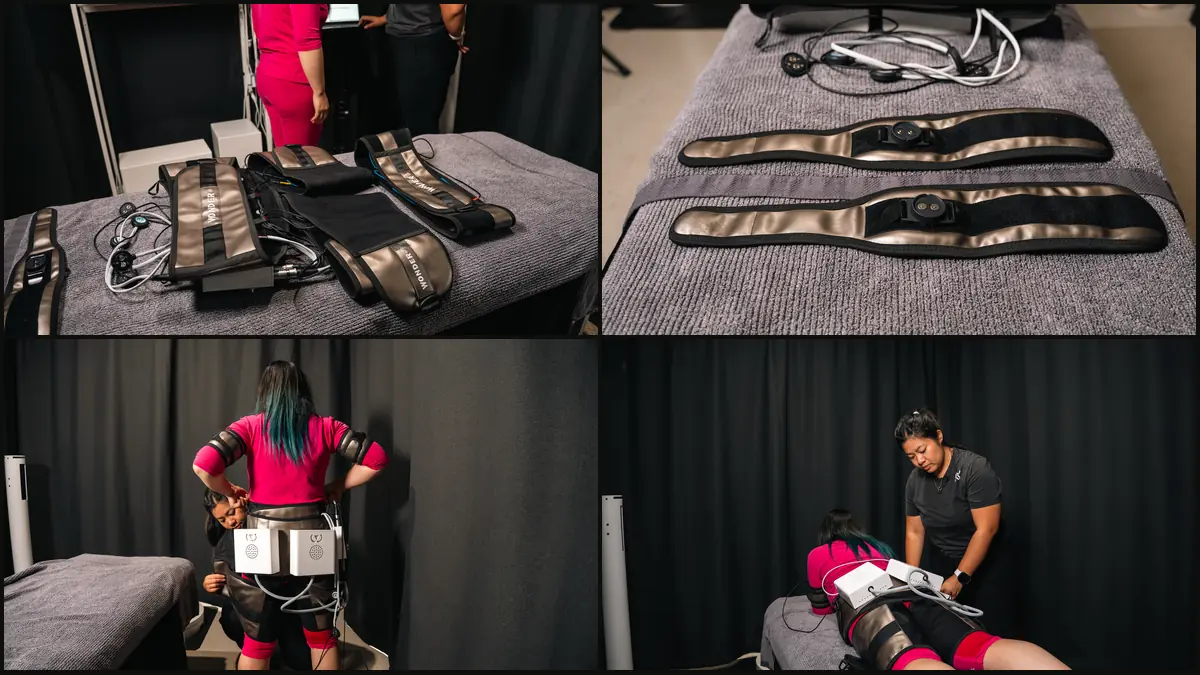
That's the gap body contouring fills. At Kaizen Therapy we use WonderAxon, which combines focused electromagnetic pulses at 1.5 Tesla with neuromuscular electrical stimulation across six independent channels. In a single 25-minute session on the abdomen, glutes or legs, the technology generates 36,000 to 52,000 supramaximal muscle contractions. That's contraction volume a gym session physically cannot match.
Those contractions force the target muscles to adapt and grow, the same way resistance training does, just without you having to lift anything. For clients who are losing weight fast on medication and losing muscle as a side effect, it's a way of loading the muscle tissue twice a week, every week, for the length of the program.
For the face, WonderFace uses bipolar radiofrequency paired with facial muscle stimulation, targeting the same loose-skin-plus-muscle-loss problem in the jawline, cheeks and neck.
Skin tightening after Ozempic and other GLP-1 medications
The skin side of the problem has its own pathway. When fat comes off quickly, collagen and elastin in the dermis don't rebuild at the same speed. That's why non-surgical skin tightening after rapid weight loss is one of the most common reasons people book a first assessment. WonderAxon's radiofrequency component reaches the deep dermal layer and triggers a collagen response there, while the muscle stimulation rebuilds the support structure sitting underneath the skin. The two happen in the same session, on the same treatment bed, at the same time. Supplements marketed for this — collagen powders and copper-peptide serums — can support skin quality but can't do the structural work; here's where peptides help and where they stop.
For facial laxity after significant weight loss, WonderFace applies the same principle to the jawline, neck and cheek area. Mid-face laxity after rapid weight loss (the "Ozempic face" pattern) responds to the same combination of RF-driven collagen remodelling and targeted facial muscle work.
Losing weight on medication and want to protect the muscle?
Book your free assessment and 3D body scan. We'll show you exactly where your body composition sits today and what the program could do.
BOOK FREE ASSESSMENT →One Client, 20 kg Down, Then 24 Days With Us
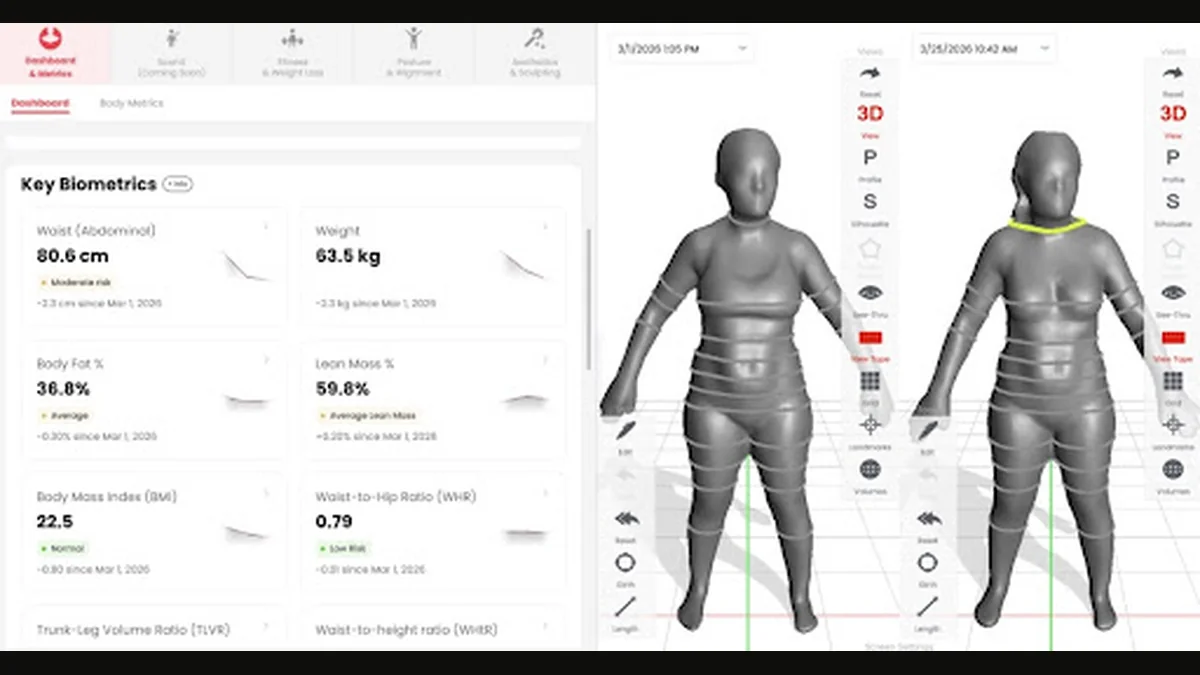
Published research is one thing. Here's what the first 24 days of treatment actually looked like for a Melbourne woman in her 40s who came to Kaizen Therapy after losing 20 kg on Ozempic over eight months. She started our 12-week program on 1 March 2026. Every number below is pulled straight from her Styku 3D body scans, taken weekly across March.
What changed in 24 days
Over three and a half weeks of twice-weekly sessions, here's what the scans recorded:
−2.3 kg total weight (from 65.8 kg to 63.5 kg, a 3.5% reduction)
−2.3 cm waist (from 82.9 cm to 80.6 cm at the abdominal landmark)
−0.3% body fat percentage (from 37.1% to 36.8%)
+0.2% lean mass percentage (from 59.6% to 59.8%)
−0.8 BMI points (from 23.3 to 22.5)
The line that matters most: her lean mass percentage went up. That's the inverse of the pattern the STEP 1 data describes for medication alone.
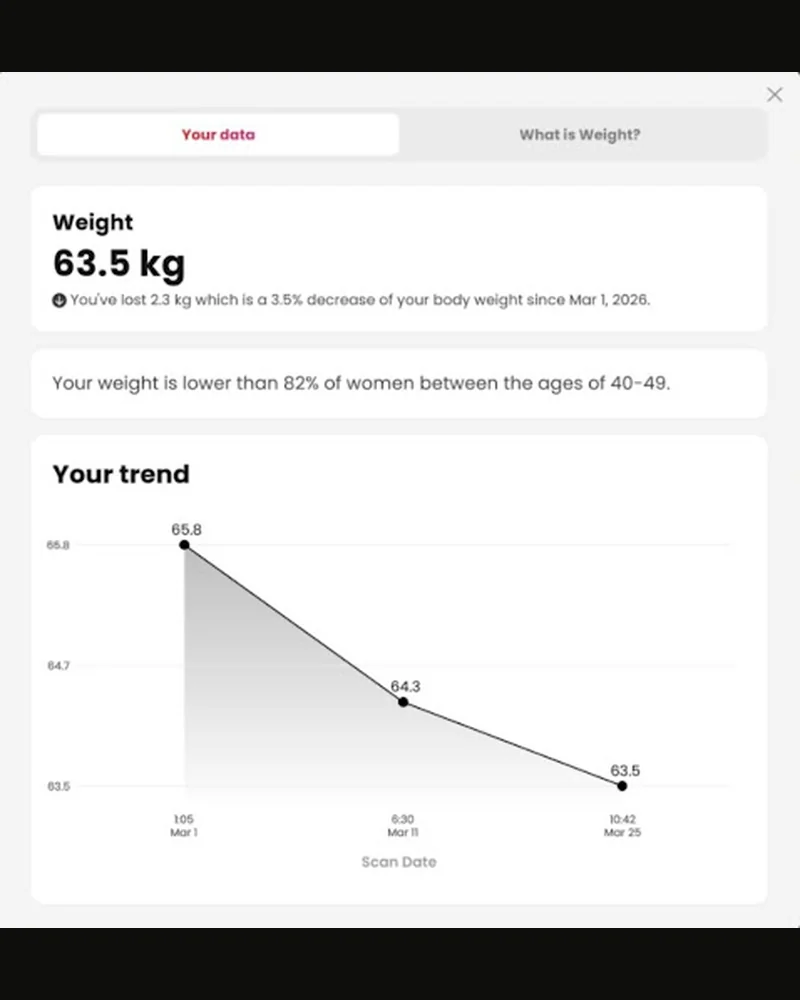
She's still on Ozempic. That's important context. The 20 kg she'd already lost before starting with us is the part the medication did. The body composition shift across March, with weight continuing to drop while lean mass percentage rises, is the part that couldn't have happened on the medication alone. That's the contribution body contouring makes.
Want to see more results across different body areas? Visit our results gallery for before-and-after comparisons from earlier clients.
What the WonderAxon Research Shows
The client case above is one data point. The clinical literature on the underlying technology is broader. The strongest feasibility study we hold on file comes from Barajas et al. (2022), a multi-centred prospective trial of 12 patients running a protocol almost identical to ours: 16 sessions over 8 weeks, twice per week, 25 minutes per session.
- 5–15% of starting body weight lost across all 12 participants
- 10.3 cm average abdominal circumference reduction (maximum observed: 15.5 cm)
- 7 cm average gluteal reduction (range: 3–11 cm)
- 4.5 cm average thigh reduction
- Visible improvement in muscle definition alongside circumferential loss
- No serious adverse events. Transient muscle soreness only, resolving within 72 hours
A separate pilot study from Ramírez Milan et al. (2020) on combined electromagnetic and neuromuscular emissions reported a "significant reduction in the thickness of adipose tissue" alongside a "very significant increase in muscle mass." In that protocol the weight change was described as negligible, because the fat loss was offset by muscle gain. That's the body recomposition pattern that shows up again in the client data above.
The general picture across the research: EMS-based body contouring does not behave like thermal fat reduction (the category that covers fat freezing, HIFU and cavitation) or like standard cardio-based weight loss. It moves fat down and muscle up in the same window. That's exactly the pattern that's useful after medication-assisted weight loss, where the goal is to protect (or rebuild) muscle while the medication continues doing the fat reduction.
Starting While On Medication vs After
Both work, and we run clients in both situations. The practical differences:
Starting while still on the medication
You're playing defence and offence at the same time. The medication is still doing its fat-reduction job, and body contouring is protecting lean mass as that loss happens. This is the most efficient window, because you're not waiting for muscle loss to accumulate before addressing it. The client above is in this category.
Starting after you've come off the medication
You're playing catch-up on the muscle side, but with the advantage of stable body weight. Your scans are easier to read, the protocol is cleaner, and the before-and-after contrast tends to be more visually dramatic. This is the most common pattern we see in new enquiries: people who finished GLP-1 therapy six to twelve months ago and are now dealing with the loose-skin-and-soft-shape phase.
Which one is right for you
The simple answer: start sooner rather than later. The muscle you haven't yet lost is easier to protect than muscle you have to rebuild from scratch. Your prescribing doctor should know you're starting a body contouring program, not because it's clinically necessary, but because they deserve the full picture of what you're doing with your body.
Cost and Program Structure
The 12-Week Body Transformation at Kaizen Therapy is priced as a program, not per session, because the protocol is designed to run as a continuous 12-week block. For Melbourne body contouring after weight loss medication, our Bentleigh studio runs the full 12-week protocol in one location, with the same practitioner across every session:
- 12-Week Body Transformation: $2,399 for 24 WonderAxon sessions, or $200/week payment plan. Includes baseline and progress Styku 3D body scans, nutrition guide, two bonus maintenance sessions and priority scheduling.
- Single WonderAxon session: $299 (25 minutes) if you'd prefer to trial before committing.
We also offer a results guarantee: complete the program with 90% attendance and if your 3D body scan doesn't show measurable improvement, you get a full refund. No fine print. See our full pricing page for details.
Frequently Asked Questions
Yes. Non-invasive EMS body contouring does not interfere with GLP-1 medications such as semaglutide (Ozempic, Wegovy) or tirzepatide (Mounjaro). The treatment works through electromagnetic muscle stimulation, not pharmacological pathways. We always review your full medical history at your free assessment, and we recommend you keep your prescribing doctor in the loop before starting any program.
Published research suggests roughly a quarter to 40% of weight lost during GLP-1 therapy is lean soft tissue rather than fat. A 2024 meta-analysis in Diabetes, Obesity and Metabolism found lean mass loss comprised 26–40% of total weight loss across semaglutide and tirzepatide trials. The STEP 1 trial of semaglutide specifically reported around 6.9 kg of lean mass loss alongside 15.3 kg of total weight loss over 68 weeks. That's the muscle component most people don't see on the scale.
It delivers a similar contractile stimulus. In a 25-minute session, WonderAxon produces 36,000 to 52,000 involuntary muscle contractions, far more than a typical gym workout. For clients who can't or won't resistance train during rapid weight loss, EMS is a practical alternative that targets the exact muscle groups most prone to loss during medication-assisted weight loss. That said, if you already have a lifting habit you enjoy, don't stop. The two approaches stack well.
No. Many of our clients come to us months or years after finishing GLP-1 therapy. The muscle that was lost during rapid weight loss doesn't automatically come back when the medication stops. Body contouring is often more effective in the post-medication phase because your body weight has stabilised and we can focus entirely on rebuilding composition, not chasing a moving target.
Body contouring builds muscle tissue, and muscle is metabolically active. It continues to support your body composition even during medication changes. If you cycle on and off GLP-1 therapy, the muscle you build at Kaizen Therapy stays with you and helps protect against the lean mass loss that usually accompanies the next round of weight loss.
A referral is not required. Your free 15-minute in-person assessment includes a full medical history review. If you're on prescription medication of any kind, we ask that you let your prescribing doctor know you're starting a body contouring program, not because it's clinically necessary, but because they should have the full picture of what you're doing.