Why Does Skin Go Loose After Rapid Weight Loss?
When you carry excess weight for months or years, your skin stretches to accommodate the additional volume. This stretching damages two critical proteins in your dermis: collagen (which provides structural strength) and elastin (which allows skin to snap back into shape).
Lose weight gradually and your skin has time to adapt, slowly contracting as the underlying fat reduces. Lose weight quickly, as many people do with modern weight loss medications like Ozempic or Mounjaro, and the skin simply can't keep up. The fat disappears faster than the collagen can rebuild, leaving behind loose, sagging skin that no amount of moisturiser will fix.
Several factors determine how much loose skin you'll be left with:
- Speed of weight loss. The faster the loss, the less time skin has to adapt.
- Amount of weight lost. Losing 20kg or more significantly increases the likelihood of loose skin.
- Age. Collagen production naturally declines from your mid-20s onward.
- Genetics. Some people naturally produce more collagen and elastin than others.
- Sun exposure history. UV damage accelerates collagen breakdown over time.
- Muscle mass. Rapid weight loss often takes muscle with it, removing the scaffolding that supports skin from beneath.
That last point is critical, and it's the one most people overlook. When weight comes off quickly (especially through medication-assisted weight loss), you don't just lose fat. You lose significant muscle mass too. The skin ends up with less fat underneath it and less muscle to give it shape and support. It's a double problem.
Loose Skin by Body Area: Stomach, Arms, Thighs, Neck and Face
After rapid weight loss, loose skin shows up in predictable places, and the right treatment differs by area. They're also the places your body stored the most fat, which is why the skin stretched furthest there.
Stomach and belly
The most common concern by a wide margin. Loose belly skin hangs or folds around the midsection, particularly below the navel, and it is usually paired with the muscle loss that rapid weight loss causes through the core. That pairing is why a skin tightening treatment for the stomach needs to do more than heat the skin surface: the abdomen responds best to approaches that rebuild the muscle wall underneath while the skin remodels above it. This is the area where EMS body sculpting has its strongest published data, and it is the most popular treatment area for our post-weight-loss clients.
Upper arms
Often called "bat wings": loose skin hanging from the tricep area. The arms carry comparatively little muscle to rebuild, so mild arm laxity suits thermal treatments, while more significant laxity paired with lost tricep tone responds better to combined muscle-plus-skin approaches.
Thighs
Inner thigh skin loses tone first, which shows up as chafing when you walk and a general reluctance to wear shorts. The thighs hold large muscle groups though, and rebuilding that quad and hamstring volume puts a lot of the support back.
Buttocks
The buttocks tend to flatten and sag rather than hang, which reads more as lost volume than extra skin. That's actually good news: the glutes are the largest muscle group in the body, and they respond strongly to rebuild.
Chest and breasts
Volume loss leads to sagging, particularly after significant weight loss. This area is the least suited to energy-based treatment and the most likely to need a surgical opinion when the change is severe.
Neck and jawline
Loose neck skin after weight loss is one of the most visible signatures of a big loss, because the neck has thin skin and almost no fat left to fill it. Radiofrequency treatments for a sagging neck tighten the dermis, and treatments that also stimulate the platysma muscle address the slackening underneath. We cover the neck and under-chin area in detail in our double chin treatment cost guide.
Face
Faces show weight loss in their own way: jowling, hollowing around the cheeks, and a general softening of the jawline. If you are wondering how to tighten your face skin after weight loss, the face is its own category with its own toolset; our HIFU vs RF vs EMS face comparison covers it properly. The short version: the face responds to the same dual skin-plus-muscle logic as the body, at much lower energy.
How to Tighten Skin After Weight Loss: Your Options
If you're researching how to get rid of loose skin after weight loss, you'll quickly find a spectrum of approaches. Every skin tightening treatment marketed in Melbourne falls somewhere on it, from conservative lifestyle changes all the way through to major surgery. Here's an honest comparison of the six most common:
Before that list, a word on the low-effort route most people try first: collagen powders and copper-peptide serums. They can genuinely improve skin quality, but they can't shrink a skin envelope that has become larger than the body underneath it — a different problem entirely. We cover what peptides can and can't do for loose skin in detail, including where the evidence runs out.
Surgery (Abdominoplasty)
Full extra skin removal surgery. Physically cuts away loose tissue and tightens what's left. The most dramatic option, but comes with significant recovery time and cost.
Radiofrequency (RF)
Heats the dermis to stimulate new collagen production. Gentle and non-invasive, but results tend to be subtle for significant loose skin.
Ultrasound (HIFU)
Focused ultrasound energy targets deep tissue layers. Fewer sessions needed, but effectiveness varies with skin laxity severity.
Laser Therapy
Laser energy heats skin to promote collagen remodelling. Effective for mild laxity, but some downtime required for skin recovery.
Cryolipolysis (Fat Freezing)
Freezes fat cells for gradual elimination by the body. Targets fat only and does nothing for skin laxity or muscle loss.
EMS Body Sculpting
Electromagnetic waves and electrical stimulation simultaneously reduce fat and rebuild muscle. The only non-invasive option that addresses both skin laxity and muscle loss.
The key distinction: most non-surgical treatments target either fat or skin, not both. And none of them address the muscle loss that's often a major contributor to the loose-skin appearance after weight loss. That's where EMS body sculpting takes a fundamentally different approach. For a side-by-side of how these technologies stack up across the body, our comparison of EMS, fat freezing, HIFU and cavitation for body sculpting goes deeper on what each one does and who it suits.
Why EMS Body Sculpting Is Different for Post-Weight-Loss Skin
RF, HIFU, and laser treatments all work by heating the dermis to stimulate collagen production. They work, to a degree. But they miss a critical piece of the puzzle: the muscle underneath.
After rapid weight loss, your skin isn't just lacking collagen. It's lacking the muscle volume that used to fill it out. Think of it like a tent with missing poles: the canvas (your skin) can't hold its shape when the support structure (your muscle) has shrunk.
EMS body sculpting addresses both problems simultaneously. The technology delivers focused electromagnetic waves at 1.5 Tesla combined with neuromuscular electrical stimulation across six independent channels. In a single 25-minute session, this generates 36,000 to 52,000 supramaximal muscle contractions, far beyond what voluntary exercise can produce.
These contractions force the targeted muscles to adapt and grow (hypertrophy), while the metabolic response simultaneously triggers fat reduction. The result: your muscles rebuild the scaffolding under your skin while excess fat continues to reduce.
- 5–15.5 cm average abdominal circumference reduction across clinical studies
- +2.0 percentage points muscle mass index gain (directly addressing post-weight-loss muscle catabolism)
- Overweight patients respond better than slimmer patients, which is the opposite of thermal treatments
- 100% patient satisfaction across 7 clinical studies with 100+ participants
- Zero serious adverse events. Only transient skin redness and DOMS-like muscle soreness (resolves within 72 hours)
- Visible results from session 2; significant changes from session 4–8
That third point deserves emphasis. Thermal skin tightening treatments (RF, HIFU, laser) tend to work best on people who are already lean and have mild skin laxity. EMS body sculpting actually produces more significant results in people with higher starting body fat. That's precisely the demographic that needs help after major weight loss.
Real Client, Real Numbers: One Month of Data
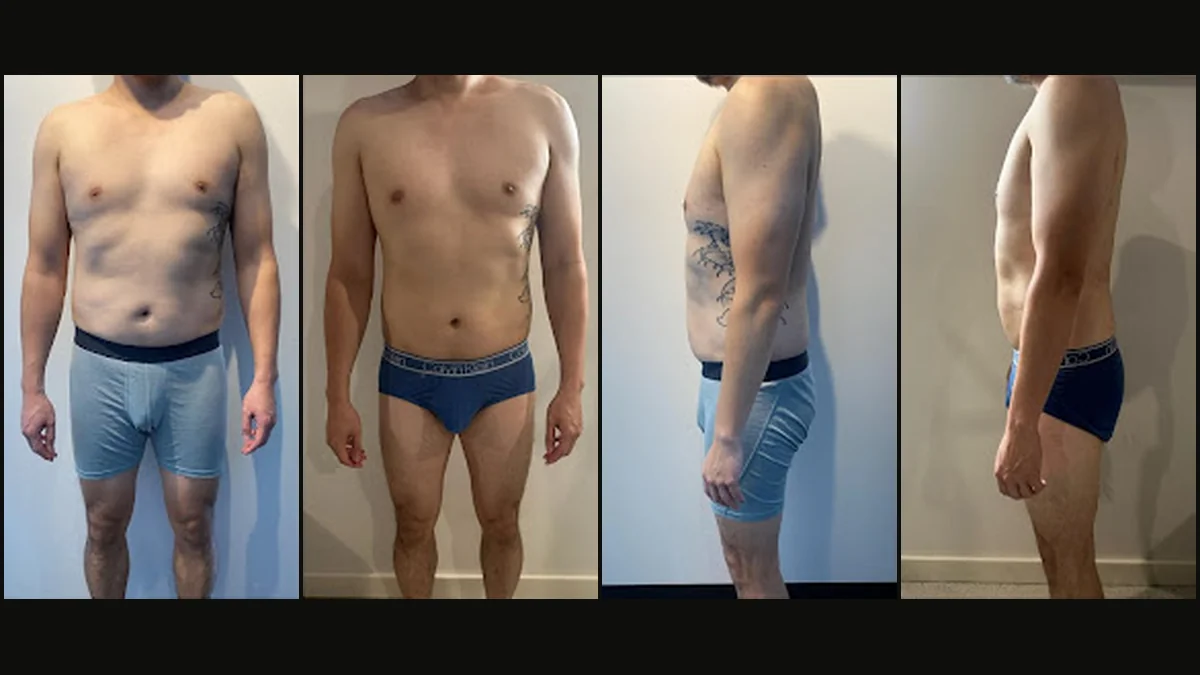
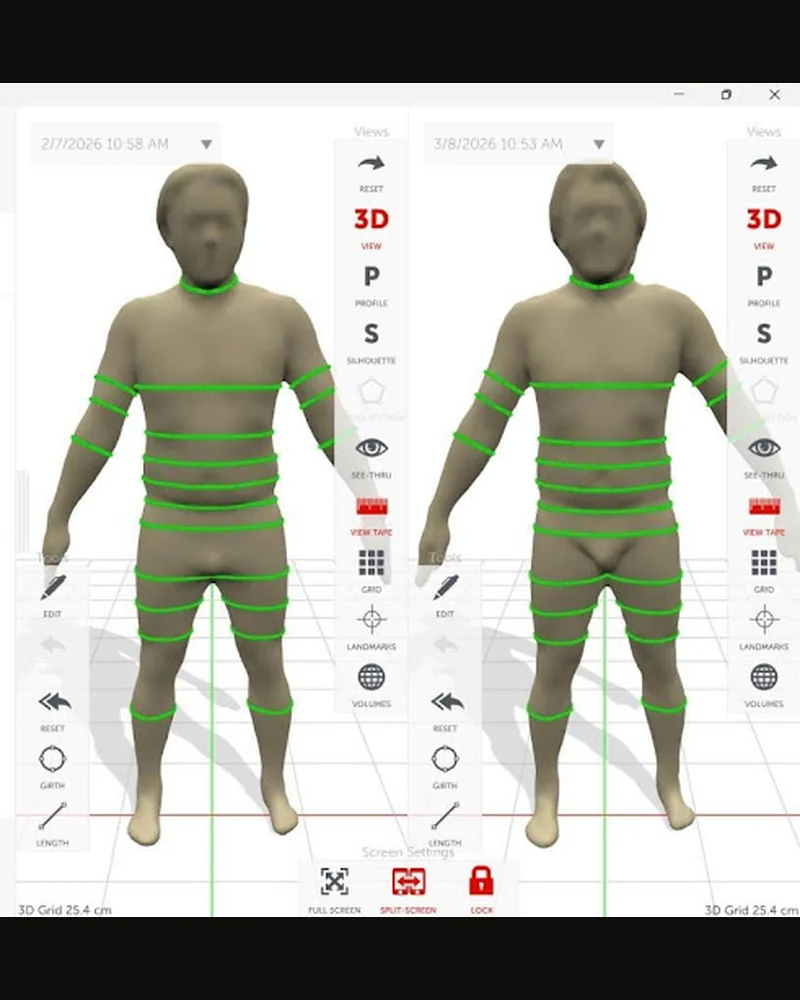
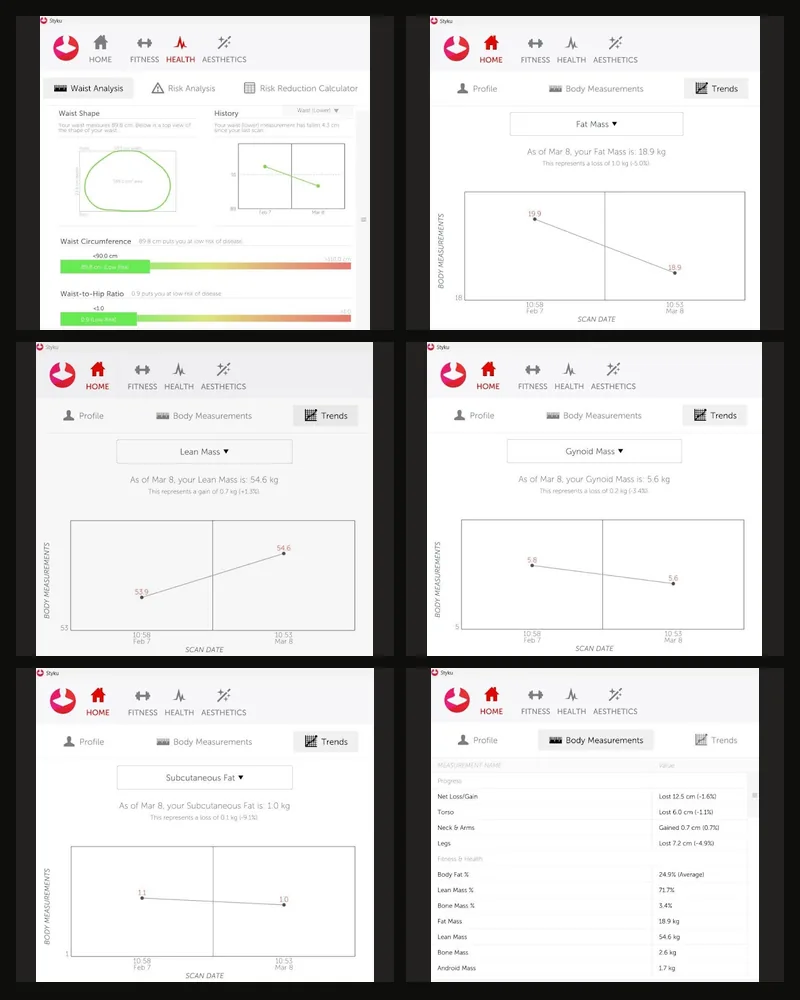
Clinical studies are one thing. Here's what the first four weeks of treatment actually looked like for one of our Bentleigh clients. He's a guy in his 40s who came to us for body recontouring after losing a significant amount of weight. Every number below is pulled straight from his Styku 3D body scans, taken on 7 February and 8 March 2026.
What the scans measured
In a single month of treatment, here's what changed on the tape:
−4.3 cm waist circumference (down to 89.8 cm, low-risk range)
−12.5 cm combined circumference loss across all measured body areas (−1.6%)
−6.0 cm torso
−7.2 cm legs (−4.9%)
+0.7 cm neck and arms (new muscle)
And underneath the skin, on the body composition side:
−1.0 kg fat mass (−5.0%)
+0.7 kg lean muscle mass (+1.3%)
−9.1% subcutaneous fat
That last set of numbers is the part a bathroom scale will never show you. He didn't just lose weight. He lost fat and built muscle at the same time. His waist came down more than four centimetres while his arms and neck actually got bigger from new muscle tissue. That's the dual-action effect thermal skin tightening treatments simply can't replicate.
Want to see more transformations? Visit our results gallery for before-and-after comparisons across different body areas.
Dealing with loose skin after weight loss?
Book your free assessment and 3D body scan. We'll show you exactly what's possible.
BOOK FREE ASSESSMENT →What to Expect During Treatment
If you're considering EMS body sculpting for post-weight-loss skin tightening, here's what the process looks like at Kaizen Therapy:
Free Assessment (15 minutes)
Every program starts with a free, no-obligation assessment at our Bentleigh studio. We use a Styku 3D body scanner to create a precise digital model of your body, measuring circumferences, body composition, and identifying your specific areas of concern. This scan becomes your baseline, and we repeat it throughout your program to track measurable progress.
Treatment Sessions (25 minutes each)
You'll change into a fitted treatment suit, and we spray the areas we're working on with warm water so the current conducts cleanly to the muscle. Then you lie down while the applicators sit against your target areas, and the device generates electromagnetic pulses that cause involuntary muscle contractions. It's an unusual sensation (like an intense workout you're not controlling) but it's not painful. Each session produces 36,000–52,000 contractions, far more than even the most demanding gym workout.
Treatment Schedule
Our 12-Week Body Transformation program includes 24 sessions over 12 weeks (twice per week, with at least 2 days between sessions). This gives your muscles enough time to progressively rebuild while your body composition shifts. Learn more about how the process works.
Recovery
There is zero downtime. You can return to normal activities immediately after each session. The most common side effect is muscle soreness similar to what you'd feel after an intense gym workout (DOMS), which typically resolves within 24–72 hours.
How Much Does Non-Surgical Skin Tightening Cost?
Transparency matters, especially when you're comparing options:
- Single WonderAxon session: $299 (25 minutes)
- 12-Week Body Transformation: $2,399 for 24 sessions, or $200/week payment plan. Includes Styku 3D body scan, progress tracking, nutrition guide, 2 bonus maintenance sessions, and priority scheduling.
For comparison, surgical skin removal (abdominoplasty) typically costs $8,000–$15,000+ in Melbourne, requires general anaesthesia, and involves 4–6 weeks of recovery. The 12-week program costs a fraction of that with zero downtime and a total value of $8,621.
We also offer a results guarantee: complete the program with 90% attendance and if your 3D body scan doesn't show measurable improvement, you get a full refund. No fine print. See our full pricing page for details.
Frequently Asked Questions
It depends on how much weight you lost and how quickly. Skin has some natural elasticity and may partially recover over 12–24 months, especially if you're younger and lost weight gradually. After rapid or significant weight loss (20kg+), though, the collagen and elastin fibres are often too damaged to fully bounce back without intervention. Factors like age, genetics, and sun exposure history also play a role.
Most clients notice visible changes from their second session. Significant skin tightening and muscle definition typically becomes apparent after 4–8 sessions (2–4 weeks of twice-weekly treatments). Our standard 12-week program includes 24 sessions, with continued improvement for several weeks after the final session as your muscles continue to adapt.
Yes. EMS body sculpting is non-invasive and does not interfere with weight loss medications such as Ozempic, Mounjaro, or Saxenda. The treatment targets muscles and fat through electromagnetic stimulation, not pharmacological pathways. Across 7 clinical studies with over 100 participants, no serious adverse events were reported. We always review your full medical history during your free assessment to ensure the treatment is appropriate for you.
The most commonly treated areas are the abdomen, upper arms, thighs, buttocks, and waist. Each area is targeted with specific applicator positions and treatment protocols. The abdomen is our most popular treatment area for post-weight-loss clients, but many people opt for multi-area programs to address arms and thighs simultaneously.
It depends on what is driving the loose appearance. If the stomach skin is mildly lax but the core muscle is intact, thermal treatments (radiofrequency, HIFU, laser) stimulate collagen and produce gradual tightening. If the loose belly skin followed rapid weight loss, the core muscle underneath has usually shrunk too, and rebuilding it matters as much as treating the skin: EMS body sculpting addresses both in the same session, which is why the abdomen is its most-studied treatment area. If the skin is genuinely redundant (hanging folds you can grip), abdominoplasty is the honest answer and no non-surgical option will replicate it. A practitioner should tell you which profile you are in before you spend anything.
Exercise is always good, but EMS body sculpting generates supramaximal muscle contractions that go far beyond what voluntary exercise can achieve, producing 36,000 to 52,000 contractions in a 25-minute session. You don't need to follow a specific exercise program for the treatment to work. Maintaining an active lifestyle and a balanced diet will complement and help sustain your results long-term.