"Non-surgical tummy tuck" is one of the most searched and most misleading phrases in body contouring. There's no such thing as a tummy tuck without surgery. There are, however, several non-surgical treatments that can genuinely flatten and firm the stomach for the right person, and a clear line where they stop working and surgery takes over.
This guide is built around that line. We'll walk through what a tummy tuck actually does, how to work out what's driving your stomach, which non-surgical tools match which problem, and when the honest advice is to see a surgeon instead. By the end you should be able to tell the difference between realistic marketing and the kind that's setting you up for disappointment.
What a Tummy Tuck Actually Does
An abdominoplasty, the medical name for a tummy tuck, does three separate jobs in one operation. It removes excess skin by cutting it away. It repairs separated abdominal muscles by stitching them back together, which surgeons call plication. And it usually removes or suctions some fat at the same time. That combination is why surgery produces the dramatic before-and-afters: it physically takes tissue away and rebuilds the muscle wall.
It's also why surgery carries what surgery carries. A tummy tuck is performed under general anaesthetic, needs roughly four to six weeks off work and exercise, and a compression garment for about six weeks. The most common complication is fluid collecting under the skin (a seroma), and overall complication rates sit in the rough range of 10 to 20% in the surgical literature, higher in patients who have lost a large amount of weight. In Australia the cost is commonly quoted between $10,000 and $30,000 once you add up the surgeon, anaesthetist, hospital and aftercare, and a purely cosmetic abdominoplasty generally attracts no Medicare rebate.
None of that is meant to scare you off surgery. For the right person it's an excellent operation. The point is that once you understand those three jobs, you can work out whether a non-surgical path gets you most of the way there.
First, Work Out What's Driving Your Tummy
A flat stomach that has changed shape is almost always some combination of three things. Before you look at any treatment, work out which is the main culprit for you, because each one responds to a completely different tool.
1. Stubborn fat
A layer of fat sitting over the muscle, the kind that doesn't shift no matter how disciplined the diet and training are. This is the most treatable driver non-surgically. Worth knowing: the fat just under the skin (subcutaneous) is what devices target. The deeper fat around your organs (visceral) responds to diet and overall weight loss, not to any machine.
2. Separated abdominal muscles
Pregnancy and significant weight changes can stretch the connective tissue between the two halves of the "six-pack" muscle, leaving a gap called diastasis recti. It's extremely common: one study of 300 women found 60% had a separation at six weeks postpartum, dropping to around a third at twelve months. That gap pushes the belly forward even when there's very little fat, which is why some very lean people still have a rounded lower tummy.
3. Loose or stretched skin
After pregnancy or large weight loss, skin that was stretched for a long time may not fully retract. This is the driver non-surgical treatments struggle with most, and the one a tummy tuck handles best.
Most people are a blend. Working out the dominant driver is the most useful thing you can do before booking anything, and it's the first thing a good assessment should tell you.
Not sure which one is your tummy?
Book a free body assessment at our Bentleigh studio. We'll do a Styku 3D scan, work out whether fat, muscle or skin is the main driver, and give you a straight answer on what non-surgical can realistically achieve for you.
BOOK A FREE BODY ASSESSMENT →The Non-Surgical Toolkit, Matched to the Driver
Once you know what's driving your tummy, the right tool becomes obvious. Here's the short version. For a deeper technology-by-technology breakdown, our comparison of EMS, fat freezing, HIFU and cavitation goes into the mechanisms in detail.
For stubborn fat: fat freezing or EMS
Cryolipolysis (fat freezing) cools a localised fat bulge to break down fat cells, with published reductions of roughly 15 to 28% of the treated fat layer per area. It's contouring, not weight loss, and it does nothing for muscle or skin. It also carries a small, real risk worth knowing about: paradoxical adipose hyperplasia, where the treated area firms and enlarges instead of shrinking, reported in pooled data at around 0.2% of treatments and needing surgical correction if it happens. Electromagnetic muscle stimulation also reduces fat while it works the muscle, which is why it's often the more efficient single choice for the abdomen.
For weak or separated muscles: EMS
High-intensity electromagnetic muscle stimulation (the technology class behind devices like Emsculpt and our own WonderAxon) drives involuntary contractions far stronger than voluntary effort. Studies on this class report abdominal muscle thickness gains of 15 to 19% and modest reductions in muscle separation, though the trials are small and mostly industry-funded, so treat the numbers with some caution. It's the closest non-surgical answer to the "muscle" job a tummy tuck does, with the honest limit covered below.
For mild skin laxity: radiofrequency or HIFU
Radiofrequency and HIFU heat the deeper skin to stimulate collagen, which can firm mild to moderate laxity over a course of sessions. Genuinely useful at the milder end. Genuinely oversold at the severe end. Professional bodies are explicit that significantly stretched skin after pregnancy or major weight loss is not something energy devices reliably fix.
The Honest Limit: When Non-Surgical Isn't Enough
Here's the part most "non-surgical tummy tuck" pages leave out. There are two situations where non-surgical treatment will reliably underdeliver, and recognising yourself in them now saves you money and disappointment later.
The first is significant excess skin. If you have a genuine apron of loose skin that hangs or folds, no amount of radiofrequency, ultrasound or muscle stimulation will remove it. As one 2021 review in Plastic and Aesthetic Research put it plainly, surgery remains the gold standard for skin laxity, and non-surgical methods are effective only for mild to moderate cases. Removing skin requires cutting it away. That's surgery, by definition.
The second is a large, true muscle separation. EMS and core training can strengthen the abdominal wall and improve how flat it looks, and they're well worth doing. But the published evidence shows the change to the actual gap is usually small and of low certainty. Surgical plication is the only intervention demonstrated to mechanically close a significant diastasis. Any clinic claiming a machine will "close" a real separation is overselling it.
If either of those is your main driver, the genuinely useful advice is to talk to a surgeon. We'd rather tell you that at a free assessment than take your money for a program that was never going to get you there.
Tummy Tuck vs Non-Surgical: Side by Side
| Factor | Tummy Tuck (surgery) | Non-Surgical Contouring |
|---|---|---|
| Removes excess skin | Yes — physically excised | No — mild firming only |
| Repairs separated muscle | Yes — surgical plication | Builds tone; won't close a true gap |
| Reduces fat | Yes (often with liposuction) | Yes — localised fat layer |
| Anaesthetic / surgery | Yes — general anaesthetic | No — non-invasive |
| Downtime | 4–6 weeks | None to minimal |
| Result onset | Immediate (after healing) | Gradual over weeks |
| Typical cost (AU) | $10,000–$30,000 | From $299/session; $2,399 program (Kaizen Therapy) |
| Best for | Significant loose skin + muscle separation | Stubborn fat, weak muscle, mild laxity, near goal weight |
The honest summary: the two aren't really competitors. A tummy tuck is the answer for significant excess skin and a large muscle separation. Non-surgical contouring is the answer for stubborn fat, muscle tone and mild laxity in someone near their goal weight. The mistake is buying one when you needed the other.
Where WonderAxon Fits at Kaizen Therapy
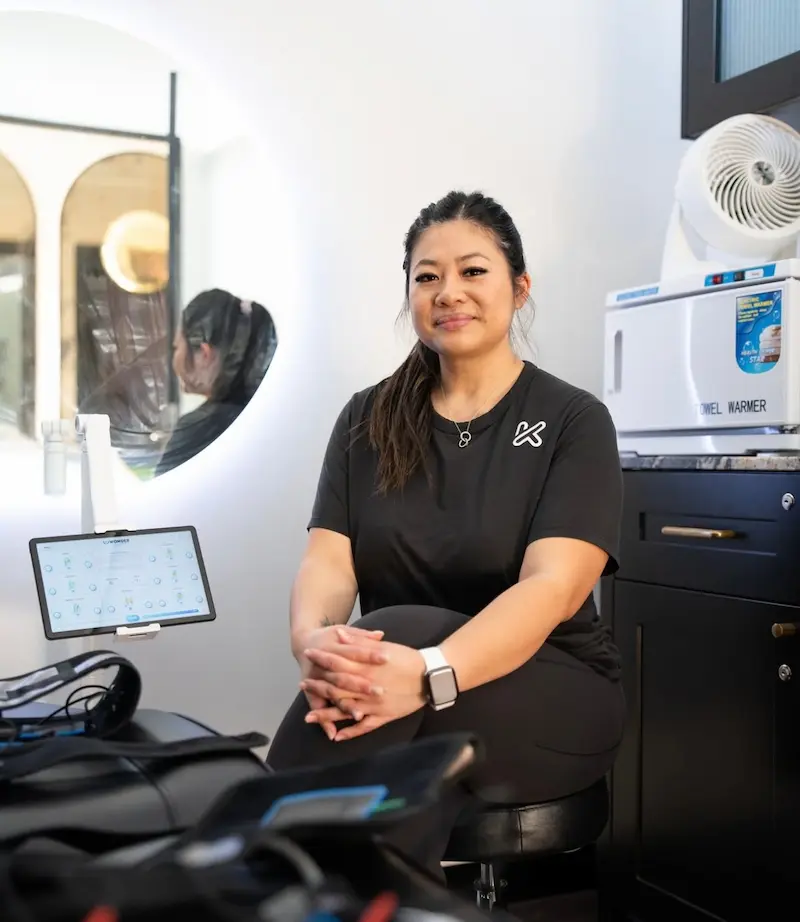
The treatment we use for the abdomen is WonderAxon, which combines high-intensity electromagnetic muscle stimulation with bipolar radiofrequency in a single 25-minute session. That pairing maps onto two of the three drivers above: the muscle stimulation rebuilds abdominal tone and reduces the fat layer, while the radiofrequency adds mild skin firming. It's built for the person near their goal weight whose tummy is about fat and tone rather than a sheet of loose skin.
Across our own program data, clients have seen abdominal circumference reductions of around 5 to 15 centimetres, averaging about 10, alongside measured gains in muscle mass and reductions in body-fat index. We track these with a Styku 3D body scan at the start and through the program, so the change is a measurement rather than a feeling. Results depend on your starting point, and we'll only recommend it if your assessment says you're the right candidate.
Everything said above applies here too. If your main issue is loose skin or a large separation, WonderAxon isn't the right tool, and we'll tell you that. If your tummy is fat and tone over a reasonable skin envelope, it's one of the most effective non-surgical options available.
See the contour before you decide anything
Every WonderAxon journey starts with a free body assessment and a Styku 3D scan, so you get an objective picture of what's fat, what's muscle, and what's skin. No pressure, no sales script. If non-surgical isn't right for your tummy, we'll tell you exactly that.
BOOK A FREE BODY ASSESSMENT →What It Costs at Kaizen Therapy
For comparison against that $10,000 to $30,000 surgical range, here's exactly what non-surgical contouring costs with us. Clear pricing is rarer in this industry than it should be.
A single WonderAxon session is $299. The structured option is the 12-Week Body program at $2,399 (or $200 per week), which includes 24 WonderAxon sessions across 12 weeks, a Styku 3D body scan and custom plan, and two bonus maintenance sessions. If you want to hold results afterwards, maintenance sessions are available from $199 a month. Your first step, the assessment and scan, is free and comes with no obligation.
If you're dealing with weight-loss-related skin changes specifically, our guide to non-surgical skin tightening after rapid weight loss goes deeper on that.
Frequently Asked Questions
It depends on what's driving your tummy. If the issue is stubborn fat, weak abdominal muscles, or mild skin laxity, non-surgical treatments can produce a genuinely flatter, firmer result. If the main issue is a large amount of loose, hanging skin, no non-surgical treatment can match what a tummy tuck does, because only surgery physically removes excess skin. The honest answer is that non-surgical works well for the right starting point and underdelivers for the wrong one. A proper assessment tells you which camp you're in before you spend a cent.
A post-pregnancy tummy is usually a mix of three things: a little residual fat, separated abdominal muscles (diastasis recti), and some skin that has been stretched. Muscle-focused EMS is often the most useful single tool because it rebuilds deep core and abdominal tone, and at Kaizen Therapy we pair it with radiofrequency for mild skin firming in the same session. What it will not do is close a true muscle separation the way surgical repair does, or remove significant loose skin. We screen for diastasis at the free assessment and tell you honestly where the line is for your body.
Not directly. Fat freezing reduces a localised fat layer and does not tighten skin. EMS works the muscle underneath, which can improve how firm the area looks, but it does not remove skin either. Radiofrequency and HIFU can help mild to moderate laxity by stimulating collagen, but professional bodies are clear that significantly stretched skin after pregnancy or large weight loss usually needs surgery to remove. If loose skin is your main concern, be wary of any clinic promising a non-surgical fix for it.
The best candidates are close to their goal weight, reasonably fit, and bothered by a specific area rather than looking for overall weight loss. Non-surgical contouring refines what's already there. It is not a weight-loss program, and it works best when there isn't a large amount of excess skin. If you're still some way from your goal weight, the sensible order is to get closer first, then refine the contour. At the free assessment we use a Styku 3D body scan to give you an objective starting point and a straight answer on fit.
A tummy tuck in Australia is commonly quoted between $10,000 and $30,000 once you include the surgeon, anaesthetist, hospital and aftercare, and a purely cosmetic procedure usually attracts no Medicare rebate. Non-surgical contouring is a fraction of that. At Kaizen Therapy a single WonderAxon session is $299, and the 12-week body program is $2,399 (or $200 per week), which includes 24 sessions, a Styku 3D scan and custom plan, and two bonus maintenance sessions. The trade-off is that non-surgical works gradually and suits a different starting point than surgery.
They can help, within limits. Research on exercise and electrical muscle stimulation shows small reductions in the gap and improvements in core strength, but the evidence is low certainty and the changes are often modest. Surgical plication is the only intervention shown to mechanically close a true separation. So the honest framing is that EMS and targeted core work can make the abdomen stronger and flatter-looking and are well worth doing, but they are not a guaranteed way to close a significant diastasis. We assess the separation at your consultation and refer on when surgery is genuinely the better path.
Sources referenced
- Dawson-Amoah K, Kelecy M, Szymanski KD. Abdominoplasty. StatPearls, NCBI Bookshelf, 2026. NBK431058.
- American Society of Plastic Surgeons. Tummy Tuck (Abdominoplasty). plasticsurgery.org.
- Ingargiola MJ, Motakef S, Chung MT, Vasconez HC, Sasaki GH. Cryolipolysis for Fat Reduction and Body Contouring: Safety and Efficacy of Current Treatment Paradigms. Plastic and Reconstructive Surgery. 2015;135(6):1581–1590. PMID 26017594.
- Mah AE, et al. Incidence of Paradoxical Adipose Hyperplasia After Cryolipolysis: A Systematic Review and Meta-analysis. Aesthetic Surgery Journal Open Forum. 2025. DOI 10.1093/asjof/ojaf142.
- Kinney BM, Lozanova P. High-intensity focused electromagnetic therapy evaluated by magnetic resonance imaging: Safety and efficacy study of a dual tissue effect based non-invasive abdominal body shaping. Lasers in Surgery and Medicine. 2019;51(1):40–46. PMC6585690.
- Kinney BM, Kent DE. MRI and CT Assessment of Abdominal Tissue Composition in Patients After High-Intensity Focused Electromagnetic Therapy. Aesthetic Surgery Journal. 2020;40(12):NP686.
- Kohan J, et al. The Efficacy of High-Intensity Focused Electromagnetic Therapy: A Systematic Review. Aesthetic Plastic Surgery. 2024. PMID 37957393.
- O'Connor KM, Kandula P, Kaminer MS. Non-surgical skin tightening. Plastic and Aesthetic Research. 2021;8:64.
- Sperstad JB, Tennfjord MK, Hilde G, Ellström-Engh M, Bø K. Diastasis recti abdominis during pregnancy and 12 months after childbirth: prevalence, risk factors and report of lumbopelvic pain. British Journal of Sports Medicine. 2016;50(17):1092–1096. PMID 27324871.
- de Oliveira LC, et al. Conservative interventions for the treatment of diastasis recti abdominis: a systematic review and network meta-analysis. Medicine (Baltimore). 2025. PMC12151038.