If you've been researching how to tighten loose skin without surgery, two names keep coming up that sound like they do the same thing: plasma fibroblast and energy-based devices like WonderFace. Both promise firmer skin. Both avoid the knife. That's where the similarity ends.
One works by deliberately injuring the surface of your skin. The other never breaks the skin at all. They carry different risks, different recovery, and very different amounts of evidence behind them. This guide compares them the way an honest practitioner would, in a consult: what each one actually does, what the research says, and which problem each is genuinely suited to. We use WonderFace, the device we run at Kaizen Therapy, as the energy-based reference point, because it's what we work with every day.
What Plasma Fibroblast Actually Is
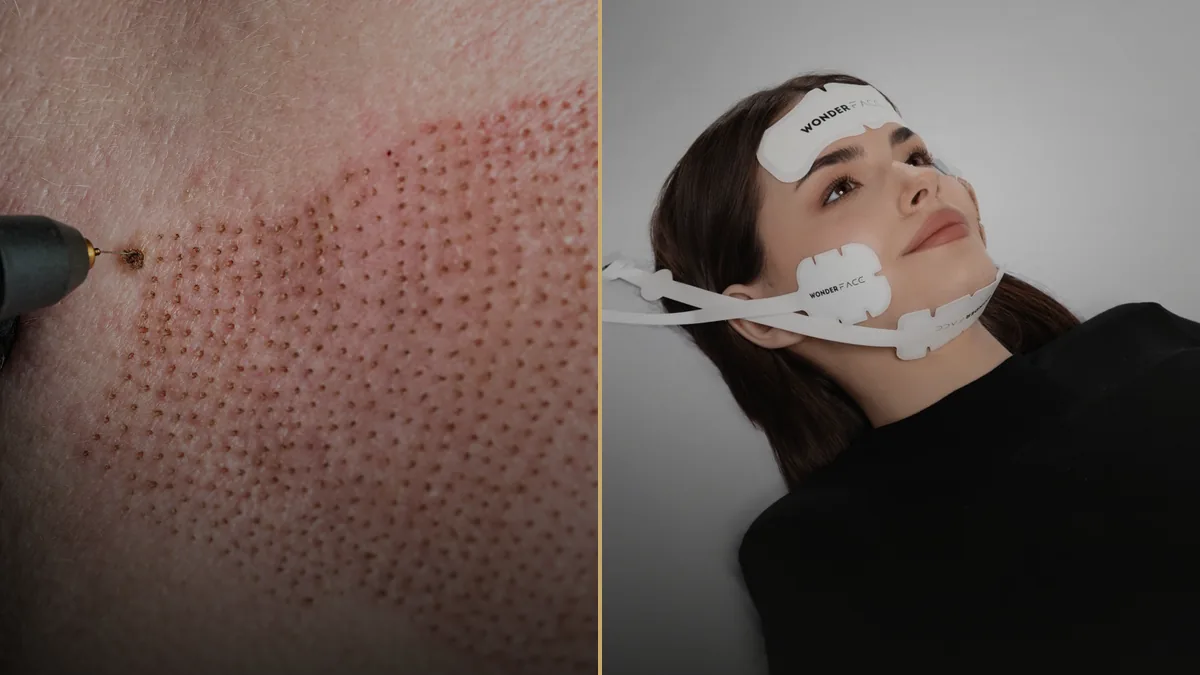
Plasma fibroblast goes by a few names: plasma pen, fibroblast therapy, plasma exeresis. The handheld device creates a tiny electrical arc, a spark of plasma, that jumps the small gap between the tip and your skin. Where it lands, it vaporises a microscopic dot of the surface and leaves a small carbon crust. The idea is that this controlled injury signals the fibroblasts, the collagen-producing cells, to mount a repair response that firms the area as it heals.
It's most often marketed for small, focal jobs. The headline use is hooded or crepey upper eyelids, sold as a non-surgical alternative to blepharoplasty. A pilot study using confocal microscopy documented collagen remodelling after plasma treatment of the upper eyelid. It ran on 10 people and the authors called for more research. A larger descriptive study of 710 cases found eyelids made up just over half the treatments, the rest spread across wrinkles, scars and small skin lesions.
The concept is real and the mechanism is plausible. How well it works, and how safely, is where the picture gets less flattering.
What the Plasma Fibroblast Evidence Really Shows
The published evidence for plasma fibroblast is thin and limited. Not absent, but not what the before-and-after galleries would have you believe.
What exists is mostly pilot studies, case series and clinic surveys, not the controlled, blinded trials that would tell you whether a treatment actually works. The eyelid pilot had no control group. The largest study measured success purely by asking patients if they were satisfied, with no objective measurement, and the authors flagged that as a limitation. One observational study of upper-eyelid treatment found something telling: patient satisfaction was higher at day 7 than at day 30, enthusiasm for a repeat treatment fell across the same window, and the researchers themselves described overall satisfaction as questionable.
The honest summary: there are no high-quality randomised controlled trials showing plasma fibroblast tightens skin with objective, measured results. A lot of the eye-catching figures you'll see quoted, the "70 to 85% improvement" type numbers, trace back to clinic marketing rather than any verifiable study. We won't repeat them, because we can't verify them.
Want a straight answer for your skin?
Book a free 15-minute in-person assessment. We'll look at your skin and muscle activity, talk through what you've researched, and tell you honestly whether WonderFace fits, or whether something else would serve you better.
BOOK FREE ASSESSMENT →Downtime, Risk, and Who's Holding the Pen
Because plasma fibroblast deliberately chars tiny dots of the skin surface, it comes with real downtime and real risk. The area crusts over with small carbon spots that need to be kept clean and left to fall off on their own, and the skin can stay red or swollen for days. That 710-case study reported full resolution taking, on average, one and a half to two and a half months.
The risks are real, and they concentrate around who performs the treatment. Plasma pens are sold widely online and used in salons, often by operators with no medical training. The published harm reports make the point bluntly. One case described second-degree burns after a plasma pen was used by a non-medical operator for breast tightening, with scarring still present at six months and no lifting effect. A separate case reported a serious chemical eye injury during a procedure near the eyelids. These are not freak one-offs. They are the predictable downside of a skin-injuring device in untrained hands.
Skin tone is a separate consideration. Any treatment that injures the surface carries a higher risk of post-inflammatory hyperpigmentation, the dark patches that can appear after healing, and that risk rises in deeper skin tones. For Fitzpatrick types IV to VI, ablative plasma warrants real caution.
On regulation, it's worth being precise rather than alarmist. In Australia, any medical device must be on the Australian Register of Therapeutic Goods before it can be lawfully supplied. We're not aware of a specific national warning that names plasma pens. The documented problem isn't a banned device, it's unregulated use: kits sold for home and salon use, marketed hard on social media, sometimes in hands that shouldn't be holding them. If you do choose plasma fibroblast, the single most important safety decision is to have a qualified medical professional perform it.
What WonderFace Does Differently
WonderFace takes the opposite approach. Instead of injuring the skin surface, it works beneath it and never breaks the skin at all. It's a Spanish-engineered, CE-certified device that combines two mechanisms in a single 25-minute session: bipolar radiofrequency and neuromuscular stimulation.
The radiofrequency runs at 500 kHz and heats the deeper dermal layer to a controlled 42 to 44 degrees. At that temperature the skin mounts a repair response: existing collagen contracts, and the fibroblasts that produce new collagen and elastin switch on. This is a well-studied pathway. Radiofrequency skin tightening has published, objective evidence behind it, which plasma fibroblast does not. Skin-biopsy research has shown a statistically significant increase in collagen after RF treatment; a 2025 systematic review of 15 studies and more than 1,200 patients found consistent improvements in skin texture and firmness with only mild, transient side effects; and a randomised controlled trial confirmed firming results against an established comparator device. That's the kind of evidence plasma fibroblast doesn't have yet.
The second mechanism is the part most people haven't come across. Each session delivers around 1,500 controlled contractions to the SMAS-layer facial muscles, the connective and muscular layer that gives the face its underlying shape, and the same layer a surgeon repositions during a facelift. Heating the skin tightens the surface; toning the muscle underneath supports the structure. One treatment, two layers. The contraction count is the device's operating specification, not a promise about your result. What it represents is a dual-layer approach that skin-only treatments don't offer.
The safety contrast is the headline. Across the published radiofrequency research there were no serious adverse events reported, and the technology has been studied across a wide range of Fitzpatrick skin types. The usual experience after a WonderFace session is mild redness that fades in 15 to 30 minutes. No crusting, no carbon dots, no recovery period.
Side by Side: Mechanism, Risk, Evidence
The fairest way to compare them is on the same axes. Read it as two different tools, not a scoreboard.
| Plasma Fibroblast | WonderFace | |
|---|---|---|
| How it works | Plasma arc burns tiny dots of the skin surface to trigger healing | Radiofrequency heats the deeper dermis, plus muscle-layer toning |
| Breaks the skin | Yes, ablative by design | No, non-ablative, no needles |
| Downtime | Carbon crusts, redness, days to weeks of healing | None, mild redness for 15 to 30 minutes |
| Best suited to | Small focal areas such as hooded eyelids | Broader laxity, jawline, midface and texture |
| Darker skin tones | Higher pigment-change risk (Fitzpatrick IV to VI) | RF technology studied across a wide range of skin types |
| Evidence base | Small, uncontrolled, satisfaction-based; no RCTs | Histological proof, an RCT, and a 2025 systematic review |
| Operator risk | Documented burns from non-medical operators | No skin ablation; trained studio delivery |
Plasma fibroblast is a focal, skin-injuring treatment with a thin evidence base and a risk profile that depends heavily on who performs it. WonderFace is a no-downtime, whole-face approach with objective research behind the underlying technology. The two tools suit different problems.
Which One Suits You
If your concern is one small area, like hooded eyelids
This is the use plasma fibroblast was built around, and if it's genuinely a single tiny spot you want addressed, it can have a place. Go in knowing what to expect: crusting and healing time, pigment risk if your skin is deeper toned, limited evidence, and the non-negotiable that it is performed by a qualified medical professional. A whole-face energy device is overkill for one eyelid.
If your concern is general laxity, jawline or texture
Loosening across the cheeks, a jawline that's blurring, the start of a double chin, skin that feels less firm than it used to. This is the broad, gradual pattern that WonderFace was designed for, and dotting a plasma pen across a whole face is neither practical nor wise. The radiofrequency-plus-muscle approach treats the area as a whole, with no downtime.
If you have a deeper skin tone
The pigment-change risk that comes with injuring the skin surface matters more here. A non-ablative approach that's been validated across a wide range of skin types is the lower-risk path, and worth weighing seriously against any treatment that crusts the skin.
Cost and Program Structure
WonderFace at Kaizen Therapy is delivered as a structured program rather than a single session, because the results in the published research come from full courses, not single sessions.
- 6-Week Facial Rejuvenation Program: $1,699. 12 WonderFace sessions delivered twice weekly across six weeks, with a skin and facial muscle assessment, progress photos at weeks 2, 4 and 6, one bonus maintenance session, and a satisfaction guarantee. Available as a payment plan from $142 per week.
- Ongoing maintenance from $199 per month. Once the program completes, monthly memberships maintain the result, with no lock-in.
Plasma fibroblast is typically priced per area and per session, with repeat treatments often needed, so a direct cost comparison is hard to make and depends heavily on the provider. The number that matters more is who is treating you and what evidence stands behind the method. Your free 15-minute in-person assessment with us confirms whether WonderFace is the right fit for your skin and goals before anything is booked. The full breakdown lives on our pricing page.
If you'd like to read how WonderFace compares to other facial options, our guides to WonderFace versus anti-wrinkle injections and HIFU, RF and EMS for the face cover the wider landscape, and the results gallery is the most complete reference we hold publicly.
Frequently Asked Questions
They are not really the same tool. Plasma fibroblast is an ablative treatment that injures tiny dots of the skin surface to trigger a healing response, and it is mostly used for small focal areas like hooded upper eyelids. WonderFace is a non-ablative device that heats the deeper skin with radiofrequency and tones the facial muscle layer underneath, with no skin damage and no downtime. The published evidence is also very different. Radiofrequency skin tightening has histological proof of new collagen, a randomised controlled trial and a 2025 systematic review behind it, while the plasma fibroblast literature is small, uncontrolled and based largely on patient satisfaction. For broad laxity, jawline and texture, WonderFace is the better fit. For a single tiny area, plasma may suit, performed by a qualified medical professional.
Yes. Plasma fibroblast leaves small carbon crusts, often described as tiny dots, where the device touched the skin. Those need to be kept clean and left to fall off on their own, and the area can stay red or swollen for days. One descriptive study of 710 cases reported that full resolution averaged around one and a half to two and a half months. WonderFace, by contrast, has no skin crusting and no recovery period. The most common after-effect is mild redness that settles within 15 to 30 minutes, after which you return to normal activity.
It carries real risks, and a lot depends on who is holding the device. Because plasma fibroblast deliberately damages the skin surface, burns, scarring and lasting pigment change are possible. Published case reports include second-degree burns from a plasma pen used by a non-medical operator, and a serious eye injury during a procedure near the eyelids. Plasma pens are widely sold for at-home and salon use, which is where much of the harm has been documented. WonderFace does not break or ablate the skin, and published research records no serious adverse events. If you are considering plasma fibroblast, have it done by a qualified medical professional, never a home kit.
Caution is needed. Any treatment that injures the skin surface carries a higher risk of post-inflammatory hyperpigmentation, which is dark patches that appear after healing, and that risk is greater in deeper skin tones (Fitzpatrick types IV to VI). This is a recognised concern with ablative plasma treatments. Radiofrequency, the technology WonderFace uses, has been studied across a wide range of skin types without that same surface-injury pathway. If you have a deeper skin tone, this difference is worth weighing carefully and discussing with a qualified practitioner before choosing.
The Kaizen Therapy program is 12 sessions delivered twice weekly across six weeks at $1,699, with a skin and facial muscle assessment, progress photos, one bonus maintenance session and a satisfaction guarantee. A payment plan is available from $142 per week. Most clients report visible change from session one or two and significant change by around session four. After the program, optional maintenance memberships from $199 per month extend the result. Your free 15-minute in-person assessment confirms the program is right for your skin before anything is booked.
Any medical device must be included on the Australian Register of Therapeutic Goods before it can be lawfully supplied in Australia. In practice, plasma pens are widely marketed online for at-home and salon use, and several documented injuries have come from devices used by non-medical operators. We are not aware of a specific national warning naming plasma pens, so the sensible takeaway is simpler: if you choose plasma fibroblast, make sure it is performed by a qualified medical professional rather than bought as a kit or done at a salon without medical oversight.
Studies referenced
- Rossi E, Farnetani F, Trakatelli M, et al. Clinical and Confocal Microscopy Study of Plasma Exeresis for Nonsurgical Blepharoplasty of the Upper Eyelid: A Pilot Study. Dermatologic Surgery. 2018;44(2):283–290. PMID 28930794.
- Tsioumas SG, Nittari G, Sagaro GG, Amenta F. A Descriptive Study on the Applications of Plasma Exeresis in Dermatology. Journal of Clinical and Aesthetic Dermatology. 2021;14(3):E58–E62. PMID 33841619.
- Ferreira FC, et al. Upper eyelid blepharoplasty using plasma exeresis: Evaluation of outcomes, satisfaction, and symptoms after procedure. Journal of Cosmetic Dermatology. 2021;20(9):2758–2764. PMID 33252188.
- Patel S, et al. Plasma fibroblast skin tightening treatment resulting in bilateral chemical eye injury secondary to EMLA cream: a case report. BMC Ophthalmology. 2020;20:342. PMID 32831067.
- Goulliart S, et al. The Dangers of Social Media as an Information Source: A Case Report of a Burn After Attempted Breast Tightening Using a PlasmaPen. Cureus. 2024;16(11):e72885. PMID 39624522.
- el-Domyati M, el-Ammawi TS, Medhat W, et al. Radiofrequency facial rejuvenation: evidence-based effect. Journal of the American Academy of Dermatology. 2011;64(3):524–535. PMID 21315951.
- Kumar N, Suh DH, Lee SJ, Ryu HJ. Radiofrequency-Based Treatments for Facial Rejuvenation: A Systematic Review of Efficacy, Safety, and Patient-Centered Outcomes. Aesthetic Surgery Journal Open Forum. 2025;7:ojaf159. PMID 41426292.
- Wang Z, et al. Long-Term Efficacy and Safety of a Novel Monopolar Radiofrequency Device for Skin Tightening: A Prospective Randomized Controlled Study. Lasers in Surgery and Medicine. 2025;57(3):259–264. PMID 39957006.