Somewhere around the four-month mark, a lot of new mums start searching two things at once: where to get a good postnatal massage, and how to get their body back. Those feel like the same goal. They aren't. A massage and a body restoration program are built for different problems, at different stages, and the most useful thing you can do is stop treating them as rivals.
One is about comfort and recovery. The other is about rebuilding muscle and strength. This guide walks through what each one actually does, what the research supports and what it doesn't, and how a new mum in Melbourne can decide where to start. Short version up front: massage first, for the early aches and tension, then body restoration once your body is ready to rebuild.
What Postnatal Massage Actually Does
Postnatal massage is soft-tissue work, hands on muscle and fascia, aimed at comfort, circulation and tension relief. After birth, that tension is real and specific: hours hunched over a feeding baby, a car seat on one arm, broken sleep that leaves the neck and shoulders permanently switched on. Most women come away feeling looser and calmer.
Worth being honest about the evidence here, because this is where massage marketing tends to overreach. The good-quality research on massage in and around pregnancy is thin, and a lot of it studies pregnant rather than postpartum women. What the better studies show is modest, short-term benefit. A small trial of massage on the second day after birth found improvements in physical discomfort and emotional wellbeing compared with bed rest. A review of massage for mood in pregnant women found a moderate benefit for anxiety and low mood, though the authors were upfront that every trial carried a high risk of bias. The fair claim: massage may support comfort and mood in the short term, not that it treats postnatal depression.
A couple of popular claims don't hold up. Massage is often sold as a way to lower stress hormones, but a careful review of the data found the effect on cortisol is very small and usually indistinguishable from zero. There's also no good evidence that massage improves sleep specifically after birth. Where massage does have a clear postpartum win is breast engorgement: a trial of manual lymphatic drainage found it eased breast pain and engorgement better than the alternatives. That's a genuine, specific benefit, not a general "flushing out toxins" claim.
- Short-term relief of neck, shoulder and back tension from feeding and carrying
- A modest lift in comfort and mood in the early weeks
- Genuine help for breast engorgement through manual lymphatic drainage
- Time to lie still, breathe, and be looked after, which counts for plenty
What "Body Restoration" Means After Birth
Body restoration is a different job entirely. Not easing tension. Rebuilding the muscle and strength that pregnancy and birth take out of you. The deep core and the abdominal wall stretch and weaken over nine months, and they don't snap back on a schedule. That's the gap restoration is trying to close, not with a massage table but with loaded muscle work.
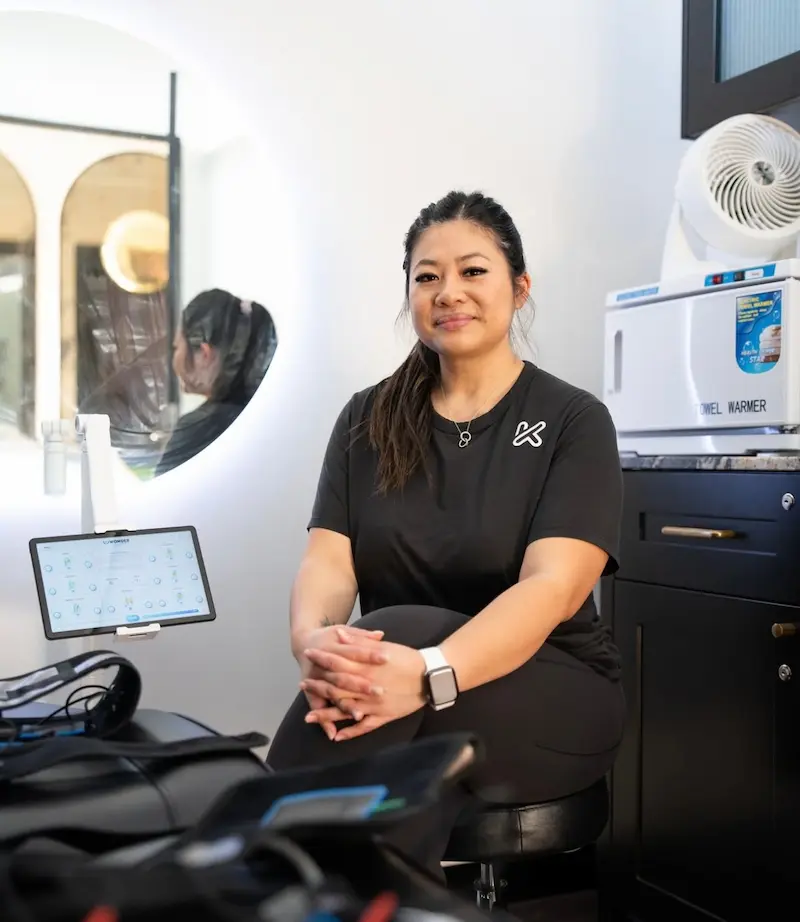
At Kaizen Therapy, the tool for that is the WonderAxon device, which uses focused electromagnetic energy to drive strong, involuntary contractions in the muscles you're trying to rebuild. You change into a fitted treatment garment and we mist the working areas with warm water so the current conducts cleanly, then for 25 minutes the device drives contractions your nervous system would never let you produce on your own. It's the same family of technology you'll see described as HIFEM or electromagnetic muscle stimulation.
The evidence here is actually firmer than it is for massage, as long as you're precise about what it shows. Pooled analyses of electromagnetic and electrical muscle stimulation find solid gains in muscle mass and strength. What that same research does not show is fat loss. The body of evidence on body fat is mixed and often not significant, so anyone promising the machine melts fat is getting ahead of the data. Smaller studies using this specific HIFEM technology on the abdomen have reported increases in muscle thickness alongside narrowing of the abdominal separation, but they're small and uncontrolled, so we treat them as promising rather than proof. The honest headline: this is muscle and strength work, with body shape following from that. Not a fat-loss shortcut.
Not sure which stage you're at?
Book a free postnatal assessment at our Bentleigh studio. We'll do a body scan, talk through where you're up to in your recovery, and give you a straight answer on whether it's a rebuild you need or simply more time.
BOOK A FREE POSTNATAL ASSESSMENT →Side-by-Side: Massage vs Body Restoration
Read this as two roles, not a winner and a loser. The columns describe what each option is good at, and when in your recovery it tends to fit.
| Factor | Postnatal Massage | Body Restoration (EMS) |
|---|---|---|
| Main job | Ease tension, aid comfort and circulation | Rebuild deep core and muscle strength |
| Best timing | Early weeks and months, once your practitioner is happy | From 6 months postpartum, after breastfeeding |
| What it targets | Soft tissue, muscular aches, breast engorgement, mood | Muscle activation, core strength, body shape |
| Evidence base | Thin, short-term, mostly studied in pregnancy | Solid for muscle and strength; postpartum data is small |
| What it won't do | Rebuild lost muscle or change body shape | Replace hands-on relief for acute tension |
| Effort required | Passive. Lie down and receive | Passive. 25-minute session, treatment garment on |
| Assessment | Practitioner judgement, no formal scan | Screening assessment plus Styku 3D body scan |
| Downtime | None | None |
The honest summary: massage is for comfort and recovery in the early stretch, with modest, short-term evidence behind it. Body restoration is for rebuilding muscle and strength later on, where the muscle research is stronger. One is not a substitute for the other.
How They Sequence Across the Postpartum Year
Think of recovery as a timeline rather than a single decision. In the early weeks and first few months, your body is still healing and your sleep is wrecked. That's massage territory: gentle, restorative, useful for the aches and the engorgement and the need to be looked after for an hour. There's no rush to load muscle in this window, and most guidance on returning to exercise after birth stresses a gradual, individualised build rather than a fixed start date.
Later, the question changes from "help me recover" to "help me rebuild". By six to twelve months, the acute healing is largely done. What's left is often weakness: a core that doesn't fire the way it used to, a midsection that feels soft no matter how careful you've been. That's when body restoration earns its place. The abdominal wall is often still a work in progress at this stage. One study following 300 women found around 60% had an ab separation at six weeks postpartum, falling to about a third by twelve months. Rebuilding a year on is completely normal.
The two even overlap comfortably once you're eligible. Plenty of women keep a regular massage going for tension and recovery while doing a course of body restoration to rebuild strength. They aren't fighting each other for the same job. Massage looks after the soft tissue and how you feel, restoration looks after the muscle.
The rebuild stage, done properly
Our postnatal recovery program uses the WonderAxon device: 25-minute sessions, twice a week, for 12 weeks. Every client starts with a free assessment and a Styku 3D body scan, so we track real change rather than guess at it. If you'd like to read how the deep core and pelvic floor recover together, our guide to pelvic floor physio vs the EMS chair vs WonderAxon covers that side in detail.
SEE THE POSTNATAL PROGRAM →The WonderAxon Approach in Plain English
Here's what a session is and isn't. You change into a fitted treatment garment and we mist the areas we're working with warm water, then it's 25 minutes of stimulation. Nothing is inserted, nothing breaks the skin. The device fires strong, rhythmic contractions through the muscles of your core and lower body, far more than you could produce at the gym, because your own nervous system limits how hard you can fire a muscle voluntarily.
You'll see a big number quoted: tens of thousands of muscle contractions in a single session. It's worth being precise about what that figure is. It's the manufacturer's specification for how the device operates, not a result it promises you. It describes the machine, not your outcome. We point that out because a lot of marketing in this space blurs the two, and you deserve to know the difference.
What you can reasonably expect is what the muscle research supports: stronger, more active core and lower-body muscles over a course of sessions, tracked against your own starting point with a 3D body scan. Some women notice a change in how their midsection feels and sits. Others are chasing strength and function more than shape. This rebuilds muscle, and body shape follows from that. It isn't a fat-loss device and we won't sell it as one. Diastasis aside, it pairs naturally with the non-surgical tummy tuck alternatives women look at after birth.
Safety, Timing and When to Wait
This is the part that matters most, and where massage and body restoration differ sharply. Massage is gentle and can usually start in the early weeks, once your own practitioner is comfortable. Body restoration has real eligibility rules, and we hold to them.
- Give it time. We start body restoration clients from six months postpartum. The body is frequently still recovering past that point, and there's no prize for rushing the rebuild.
- Breastfeeding is a wait, not a no. Active breastfeeding and pregnancy are both contraindications for the WonderAxon device, so we wait until breastfeeding is complete. Gentle massage, by contrast, is generally fine while feeding. You can still come in for your assessment and scan beforehand.
- C-section needs clearance. If you had a caesarean, we ask for GP clearance and at least six months of healing, and we tailor the early sessions around your scar.
- Some conditions rule the device out. Electronic or metallic implants such as a pacemaker, epilepsy, certain heart conditions and a few other health issues are contraindications. We screen for all of this at the free assessment, which is the whole point of doing one.
When you book either, ask the same blunt questions: who assesses me, what are they checking for, and how will we know if it's working? A good provider has a clear answer. If the answer is "just trust the process," keep looking.
Cost and Program at Kaizen Therapy
Vague pricing is one of the most common complaints about this industry, so here's exactly what the body restoration program costs and what's in it.
The 12-week program is $2,399. That covers 24 sessions (two per week across 12 weeks), three Styku 3D body scans to track change objectively, your postnatal recovery plan, access to the client portal, two bonus maintenance sessions, and direct support from the studio. There's a payment plan of $200 per week for 12 weeks, with no interest and no credit checks.
Massage pricing sits separately and varies by provider, and a one-off massage is a far smaller outlay than a structured rebuild, which is part of why the two suit different moments. Your first step with us is free: a 15-minute postnatal assessment and body scan, no obligation. If we don't think you're ready yet, whether you're still breastfeeding, would benefit from hands-on physiotherapy first, or simply need more time, we'll tell you. You can book that free assessment here.
Frequently Asked Questions
In most cases, massage comes first. It is gentle, it suits the early weeks and months when your body is still tender, and it helps with comfort, muscular tension and the aches that come with feeding and carrying. Body restoration is a later-stage tool aimed at rebuilding deep core and muscle strength, and we start clients from six months postpartum and not while breastfeeding. So the usual order is massage early for recovery and comfort, then body restoration once you are eligible and ready to rebuild. They are not competing options, they are two stages of the same recovery.
Yes, once you are eligible for body restoration there is no reason the two cannot run alongside each other, because they target different things. Massage works on soft tissue, circulation and how you feel day to day. Body restoration works on muscle activation and strength. Plenty of women keep a regular massage for tension and recovery while doing a course of body restoration to rebuild their core. Always tell both practitioners what else you are doing so your week is not overloaded.
We start clients from six months postpartum, and not while breastfeeding. Pregnancy and active breastfeeding are both contraindications for the WonderAxon device, so we wait until breastfeeding is complete before any sessions. You are welcome to come in earlier for your free assessment and body scan so you are ready to begin the moment you are eligible. Massage, by contrast, can usually start much sooner, often within the first weeks, once your own practitioner is happy.
It can support the deep abdominal muscles, but it is not a guaranteed fix for a separation. Research on core strengthening after birth shows you can build abdominal strength and muscle thickness without making a separation worse, and a separation often narrows on its own over the first year. We screen for diastasis at your free assessment, and if it needs hands-on physiotherapy attention first, we will tell you. Body restoration is one part of rebuilding the core, not a standalone answer to ab separation.
Gentle postnatal massage is generally fine while breastfeeding, and many women find it helpful for the neck and shoulder tension that comes with feeding. Body restoration is different. Active breastfeeding is a contraindication for the WonderAxon device, so we do not run sessions until breastfeeding is complete. You can still come in for your free assessment and body scan beforehand so you are ready to start when the time is right.
The 12-week program is $2,399. That covers 24 sessions (two per week for 12 weeks), three Styku 3D body scans, your postnatal recovery plan, the client portal, two bonus maintenance sessions and direct studio support. There is a payment plan of $200 per week for 12 weeks, with no interest and no credit checks. Your initial assessment and body scan are free and carry no obligation.
Studies referenced
- Yamasaki A, et al. Effect of postpartum massage on physical discomfort and mood: a randomised controlled trial. European Journal of Midwifery. 2026. PMID 41626012.
- Hall HG, McKenna LG, Griffiths DL. Complementary and alternative medicine for induction of labour. Midwifery. 2020;91:102818. PMID 32827841.
- Moyer CA, Seefeldt L, Mann ES, Jackley LM. Does massage therapy reduce cortisol? A comprehensive quantitative review. Journal of Bodywork and Movement Therapies. 2011;15(1):3–14. PMID 21147413.
- Doğan H, et al. The effect of manual lymphatic drainage on breast engorgement. Breastfeeding Medicine. 2021;16(1):82–87. PMID 33030349.
- Kemmler W, Weissenfels A, Willert S, et al. Efficacy and safety of whole-body electromyostimulation: a systematic review and meta-analysis. Frontiers in Physiology. 2021;12:640657. PMID 33716787.
- Choi EJ, et al. Effects of electrical muscle stimulation on abdominal obesity: a randomised, double-blind, sham-controlled trial. Journal of the Nepal Medical Association. 2018;56(214):904–911. PMID 31065133.
- Kinney BM, Lipner SR. Single treatment of the rectus abdominis with HIFEM technology. Lasers in Surgery and Medicine. 2019;51(1):40–46. PMID 30302767.
- Sperstad JB, Tennfjord MK, Hilde G, Ellström-Engh M, Bø K. Diastasis recti abdominis during pregnancy and 12 months after childbirth: prevalence, risk factors and report of lumbopelvic pain. British Journal of Sports Medicine. 2016;50(17):1092–1096. PMID 27324871.
- ACOG. Physical Activity and Exercise During Pregnancy and the Postpartum Period (Committee Opinion No. 804, Summary). Obstetrics & Gynecology. 2020;135(4):991–993. PMID 32217974.