The short version: people search for "face slimming without surgery" or "face fat loss treatment" as if a fuller face were one problem with one fix. It isn't. At least six separate things make a face look rounder or heavier, and they answer to completely different tools. Weight loss fixes one of them. Surgery is the only route for another. Massage helps a third for about a day; we compared professional facial massage with EMS face toning in a separate guide. Sorting yours is the whole job, and it is the part most clinics skip. Here is the map.
| What you see | Most likely cause | What actually helps |
|---|---|---|
| Whole face fuller, body weight up too | Body-weight facial fat | Weight loss (the face follows the body) |
| Round mid-cheek, even at a lean weight | Buccal fat pad | Surgery only, and often best left alone |
| Fullness under the chin | Submental fat | Fat freezing, RF plus muscle stimulation, or liposuction |
| Puffy in the morning, flatter by lunch | Fluid retention | Salt, alcohol, sleep, lymphatic support |
| Square, wide lower jaw | Masseter muscle bulk | Muscle-relaxing injections (short-term) |
| Heavy lower face, soft jawline, jowls | Descent and skin laxity | Muscle toning plus collagen (this is WonderFace's lane) |
Why "Face Fat" Is the Wrong Name for Most of It
The face does not carry fat as one continuous layer. A landmark cadaver study by Rohrich and Pessa, published in Plastic and Reconstructive Surgery, showed that facial fat is partitioned into discrete compartments, each with its own boundaries: nasolabial fat, three cheek compartments, three forehead compartments, orbital fat, and jowl fat sitting lowest of all. Their conclusion was that the face "does not age as a confluent or composite mass". Different compartments change at different rates, and some of them slide rather than shrink.
That matters here because "slimming" your face means different things depending on which compartment, or which non-fat tissue, is doing the work. Some of these respond to diet. Others respond to nothing but a scalpel, and a few aren't fat at all. A treatment aimed at the wrong one costs you money and changes nothing, which is the experience most people have had by the time they find this page.
The Six Things That Make a Face Look Fuller
Most people have two or three of these at once. Read all six before deciding which is yours, because the last one is the most commonly misdiagnosed.
1. Body-weight facial fat
This is the one that behaves the way people expect. The subcutaneous fat across the cheeks, jaw and neck tracks your overall body fat closely. A 2018 review in Frontiers in Psychology pooled the evidence and found that people can estimate someone's BMI from their face alone with a correlation of 0.71, which is strong. The same review reports that a change of roughly 1.3 BMI points, a few kilograms for most adults, is enough for observers to notice a difference in the face. If your face got fuller at the same time your weight went up, this is your answer, and the honest fix is the unglamorous one. The face follows the body.
There is a well-known catch. Lose that weight quickly, especially with weight loss medication, and the fat goes while the stretched skin and the softened jawline stay. That "gaunt but heavy" look is not fat. It is laxity, and we cover it in our guide to skin tightening after rapid weight loss.
2. The buccal fat pad
Deep inside each cheek, between the chewing muscles, sits a separate structure called the buccal fat pad. It is not subcutaneous fat and it does not play by the same rules. A 2024 anatomical review puts its average volume at around nine to ten millilitres, and states plainly that "there is no correlation between the volume of the buccal fat pad and overall individual body weight or fat distribution". You can be lean everywhere and still have full mid-cheeks, because the pad ignores your diet.
Two things follow. First, no non-surgical treatment reaches it. Not fat freezing, not radiofrequency, not muscle stimulation, not massage. The only way to reduce the buccal pad is to remove it surgically, and if that is genuinely your issue, that is the honest answer. Second, the same review notes the pad shrinks naturally with age and its loss reduces support for the cheek. That is why many surgeons now hesitate to remove it in younger faces. We have written a full guide to buccal fat removal in Melbourne, covering cost, risks and the ageing concern, if you are weighing it up.
3. Submental fat (the double chin)
Fullness under the chin is its own compartment and its own conversation. It responds to weight loss, but often less than the rest of the face, and it is one of the few areas where a non-surgical fat treatment has solid evidence. The pivotal cryolipolysis trial that led to chin fat freezing being cleared treated 60 people and measured an average fat-layer reduction of two millimetres on ultrasound, with 83 percent of subjects satisfied. Two millimetres is real but modest, and it does nothing for loose skin above it. Because the double chin has so many separate causes, we gave it its own article: double chin removal in Melbourne, including how to tell fat from skin from muscle.
4. Fluid puffiness
If your face is fullest first thing in the morning and settles through the day, you are looking at fluid, not fat. Salt, alcohol, lying flat for eight hours, poor sleep, hormones and allergies all push fluid into the loose tissue of the face, and it drains again once you are upright and moving. This is the cause that all the viral "face slimming" routines actually act on. An eight-week randomised trial of daily gua sha and facial-roller massage measured contour reductions of about two to three millimetres, roughly the point where a change becomes visible. The authors were careful to add that they had no follow-up data and could not say whether any of it lasts. In practice it lasts hours. It's genuine, cheap and temporary, and it's the one thing on this list a jade roller can actually do.
5. Masseter muscle bulk
A square, wide lower jaw is often not fat at all. It is the masseter, the main chewing muscle, grown large through clenching, grinding or simply genetics. The standard non-surgical option is relaxing the muscle with botulinum toxin injections so it slims over a few months. A 2026 meta-analysis of five randomised trials covering 536 people found a consistent short-term improvement in masseter prominence, while noting that the effect wears off and needs repeating. This is a prescription treatment from a medical practitioner, not something we offer, and it is the wrong tool if your issue is skin or fat rather than muscle. A simple self-test: clench your teeth hard and feel the angle of your jaw. If a firm block of muscle bulges under your fingers, that is masseter.
6. Descent and laxity that read as heaviness
Here is the one most people miss. From the mid-thirties the muscles of the lower face lose tone, the skin loses collagen, and the fat compartments above the jaw begin to slide downward. The cheek flattens, the jawline blurs, and a soft fold gathers at the corner of the jaw. None of that is extra fat. It is the same tissue, sitting lower and held less firmly. But in the mirror it reads as a heavier, fuller lower face, and people go looking for fat treatments when the actual problem is structure. If your weight has not changed but your face has got "heavier" over the years, this is almost certainly your cause. It's the one WonderFace is built for, and it overlaps heavily with what we cover in sagging jowls without surgery.
Not sure which one you have?
Book a free 15-minute in-person assessment at Kaizen Therapy in Bentleigh. We'll look at the fat, the fluid, the muscle and the skin, and tell you honestly which of the six is driving your face, including the ones we don't treat ourselves.
BOOK FREE ASSESSMENT →What WonderFace Does for a Fuller-Looking Face
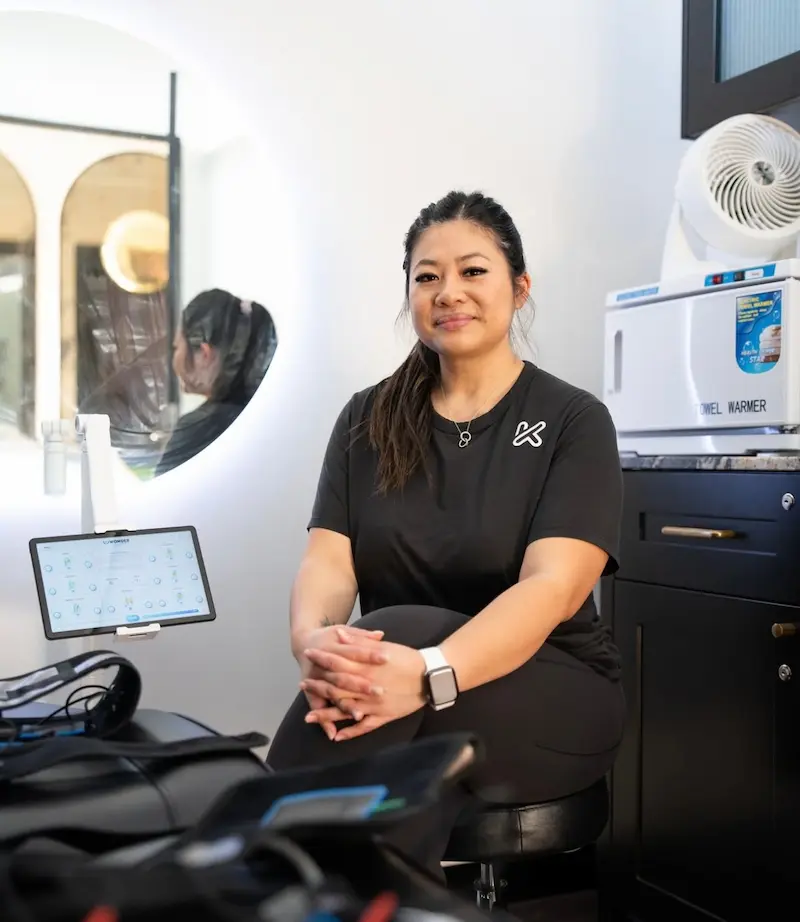
WonderFace is the facial contouring treatment we run at Kaizen Therapy. If you found it while searching for a face fat reduction treatment or a slim face treatment in Melbourne, one thing needs saying first: it's not a fat treatment. Here's which of the six causes it actually addresses.
It works on two layers in the same 25-minute session. The first is bipolar radiofrequency, which warms the deeper skin to a controlled 42 to 44 degrees to drive new collagen and elastin over a course of sessions. That is the part that firms the skin envelope of the lower face and neck. The second is neuromuscular stimulation, around 1,500 controlled contractions per session, aimed at the muscles that frame the face: the zygomaticus muscles that lift the cheek, the platysma and submandibular muscles that shape the jaw and neck, and the frontalis above. The device treats three zones, and the submaxillary zone under the jaw exists specifically for the double chin and jawline.
Put those together and the face can read slimmer, for three honest reasons. Toned muscle under the jaw sharpens the line between face and neck. A lifted cheek pulls the soft tissue back up where it used to sit, so the lower face looks less heavy. And the muscle activity plus warmth moves fluid, which is why face puffiness reduction is one of the clearest outcomes recorded in the published studies. That is cause four and cause six on the list, with a real contribution to cause three where the double chin is partly muscle slackening rather than pure fat.
What it does not do is remove fat. It will not shrink the buccal pad, it will not replace weight loss if your whole face is carrying weight, and it will not slim a masseter that needs relaxing. Kept in its lane, it is a genuine option for the heavy, soft, undefined lower face that fat treatments and surgery are not designed for.
What the Published Evidence Shows
WonderFace sits on a reasonable evidence base for a non-surgical facial device: eight published studies covering more than 200 subjects across seven countries, with the largest single trial enrolling 85 people in Perth. The figures below are what those studies recorded. They are averages across study groups, not a promise for any one face, and individual response varies.
- 70% jawline improvement recorded in the treated group
- 75% midface and cheek lifting, pulling soft tissue back up off the jaw
- 100% reduction in facial puffiness reported across the study
- Up to 25% increase in facial muscle tone after 8 to 12 sessions
- 200+ subjects across 8 studies in 7 countries
- Validated across Fitzpatrick skin types I to V, ages 25 to 70
- No serious adverse events recorded across any study
Independent research on the same class of technology points the same way. A 2025 study in Aesthetic Surgery Journal of 37 people treated with synchronised radiofrequency plus facial muscle stimulation measured the main cheek-lifting muscle thickening from 2.06 to 2.80 millimetres on ultrasound, with a 39 percent rise in its electrical activity and measurable upward shift of the skin. A separate MRI study of a submental version of the same technology recorded a 30 percent drop in fat under the chin at three months, with the muscle floor of the mouth sitting higher. Those two trials used a different manufacturer's device, so we quote them for what they say about the mechanism, not as WonderFace results. The point is that muscle plus radiofrequency in the lower face is now supported by imaging, not just photographs.
Two points of honesty about all of these numbers. None of the studies are comparative: they do not claim that this approach beats fat freezing, injections or surgery, and neither will we. And the strongest WonderFace figures are for lift, definition and puffiness, not for fat volume. If your goal is to lose actual fat from the face, this is not the tool that does that.
What It Won't Fix (Said Plainly)
The fastest way to waste money on your face is to buy a treatment aimed at the wrong cause. So here is the plain version of where WonderFace, and non-surgical skin-and-muscle treatment in general, is the wrong tool.
- A round mid-cheek at a lean weight. That is the buccal fat pad. Nothing non-surgical reaches it. The straightforward path is a consultation with a facial plastic surgeon, and a candid conversation about whether removing it is wise at your age.
- A whole face carrying body weight. If your face and your body have both got fuller, the face will follow the body back down. Toning and tightening the face while the weight stays is polishing the surface of a bigger picture.
- A square jaw from masseter bulk. Muscle stimulation builds muscle tone. It is the wrong direction for a muscle that is already too large, and the right tool is a prescription muscle relaxant from a medical practitioner.
- Severe skin excess. If there is redundant, hanging skin along the jaw and neck, no energy device reclaims it. That is a surgical conversation, and we will say so.
None of this rules WonderFace out. Most fuller faces are a mix, and the puffiness-plus-laxity part is real and treatable. It just means the plan should match each part of your concern to the tool that actually treats it, and that a good assessment says no to the parts we can't help.
How to Get a Slimmer Face Without Surgery: A Sensible Order of Operations
If you want a slimmer-looking face and you are not sure where to start, this is the order we would suggest, cheapest and most reversible first.
- Rule out fluid. For two weeks: less salt at night, less alcohol, sleep with your head slightly raised, and get moving in the morning. If the face changes noticeably, a good part of your fullness was fluid, and you have found the cheapest fix on this page. Puffiness that is sudden, one-sided or never settles is a GP conversation first, not a treatment one.
- Check the scales. If your body weight is up, the face is part of that story, and no facial treatment substitutes for the general fix. Do the general fix first, then reassess what is left.
- Sort what remains. With fluid and weight accounted for, what is left is structural: buccal pad, masseter, submental fat, or descent and laxity. Use the clench test for masseter. Pinch under the chin to feel for a genuine fat pad versus loose skin. Look at whether the mid-cheek is round or whether the lower face is simply heavy and undefined.
- Match the tool. Buccal pad means a surgical opinion. Masseter means a medical practitioner. Submental fat with firm skin means a fat treatment. A heavy, soft lower face with a blurred jawline means muscle toning plus collagen, which is where we come in.
Who This Actually Suits
You are a good candidate for the non-surgical route if your face has got heavier or less defined over the years without your weight changing much, if your jawline has softened, if you carry puffiness that never fully settles, or if a soft fold is gathering at the corner of your jaw. You want to avoid needles and surgery. You are comfortable with a gradual result rather than an overnight one, and you would rather firm and lift the face than change it in an obvious way. Men ask about this more often than you might expect, and for the same reasons: no needles, and a result that looks like a better version of the same face.
You are better sent elsewhere if your fullness is a lean-body round cheek, a square masseter or a whole face carrying weight. We would rather point you to the right practitioner, or the right plan, than sell you six weeks of the wrong treatment. That is the entire point of the assessment.
Cost and Program Structure
WonderFace is sold as a single program, because the published results live in the cumulative course rather than in one-off sessions. Muscle tone builds session on session, and collagen takes weeks to remodel, so definition improves gradually across the course rather than in a single visit. The current offer:
- 6-Week Facial Rejuvenation: $1,699. 12 WonderFace sessions delivered twice weekly over six weeks, plus skin analysis, a treatment plan, progress photos at weeks 2, 4 and 6, and one bonus maintenance session. Available as a payment plan from $142 per week, and backed by our satisfaction guarantee.
- Ongoing maintenance from $199 per month. Once the program is complete, monthly memberships help hold the result, with tiers running up to twice-weekly sessions and no lock-in.
The full breakdown lives on our pricing page, and you can see face-program comparisons in our results gallery. Your free 15-minute in-person assessment is where we confirm which of the six causes you have, and whether the program is the right fit, before anything is booked.
Frequently Asked Questions
It can make a face look slimmer. Here's how. WonderFace does not remove fat. It tones the muscles along the jaw, neck and cheek and builds collagen in the skin above them, so the jawline reads sharper, the cheek sits higher and fluid puffiness settles. The published studies recorded that as a 70 percent jawline improvement, a 75 percent midface lift and a marked drop in facial puffiness. If your fullness is mostly puffiness, softening definition or a heavy lower face, that is a real change. If it is mostly body-weight fat or the buccal fat pad, the honest answers are weight loss and surgery respectively, and we will say so at your assessment.
Usually, yes, and more than most people expect. Facial fat tracks body fat closely enough that observers can estimate someone's BMI from their face alone, and a change of roughly 1.3 BMI points is enough for people to notice a difference in the face. So if you carry weight generally, the face follows the body. The exceptions are the buccal fat pad, which does not correlate with body weight and stays put through weight loss, and the loose skin and softened jawline that rapid weight loss can leave behind. Those two need different tools, which is exactly why weight loss alone sometimes disappoints.
Temporarily, and only the fluid part. An eight-week randomised trial of daily gua sha and facial-roller massage measured facial contour reductions of about two to three millimetres, which is around the threshold where a change becomes visible, but the authors reported no follow-up data and flagged that they could not say whether the change lasts. What massage moves is fluid. It does not shrink fat, shift the buccal pad or rebuild a jawline. If your face is puffiest in the morning and flatter by lunch, massage will help for a few hours. If it is the same all day, it will not.
No non-surgical option is permanent, and anyone who tells you otherwise is selling. Fat freezing on the chin removes a proportion of fat cells, but weight gain refills the rest. Masseter injections wear off over months and need repeating. Massage lasts hours. WonderFace results hold for several months after a course and are maintained with occasional sessions, in the same way a toned body needs the gym. The only truly permanent change is surgical removal of the buccal pad, and that permanence is exactly why surgeons now caution against it in younger faces: the pad shrinks with age anyway, and what was removed cannot be put back.
Not directly, because they work on different tissue. Buccal fat removal takes out a deep fat pad that sits inside the cheek between the muscles. No non-surgical device reaches it. WonderFace works on the muscles and skin of the lower face, which is why it suits a heavy or undefined lower face rather than a specifically round mid-cheek. That said, a lot of people who search for buccal fat removal are really bothered by a soft jawline or a puffy lower face, and for them the muscle-and-skin route is the more sensible first step. If you are weighing surgery, our guide to buccal fat removal in Melbourne covers the cost, the risks and the ageing concern in detail.
The published studies recorded a visible change from session one or two, with the clearer difference by session four, and individual response varies. The Kaizen Therapy program is 12 WonderFace sessions over six weeks at twice-weekly cadence ($1,699, or from $142 per week on a payment plan), followed by optional monthly maintenance from $199. Each session is 25 minutes, with no needles and no downtime. Your free assessment confirms whether the program suits your face and the type of fullness you have before anything is booked.